16 Most Haunted Places in Seville: Self-Guided Ghost & Legends Tour
On a quiet street in Seville, a skull once hung from the wall. It belonged to Susona — a young woman whose betrayal shattered her family, and whose ghost still haunts Calle Susona, if the locals are to be believed.
By day, Seville dazzles with sunshine, orange blossoms, and café buzz. But after dark? It shifts. Shadows stretch across centuries-old alleyways. Whispers float through ancient plazas. This is haunted Seville — and it’s one of the most atmospheric cities in Europe, especially at Halloween.
I know these stories because I’ve lived them. I worked inside two of Seville’s most haunted buildings, and I’ve walked these streets with people who grew up hearing the legends.
In this guide, you’ll follow a DIY ghost tour through Seville’s most haunted places — from Santa Cruz and the Alcázar to the city centre and Triana — uncovering the spooky side of the city that most visitors miss.

Some of the links on The Seville Guide are affiliate links. If you click through and make a purchase, we may earn a small commission. This allows us to create more helpful and honest guides that you can use for free. You can read our Disclosure Policy here. We appreciate your support, thank you.
Why Seville is the Perfect City for Halloween
If you’re visiting Seville in October, you’ll probably notice that Halloween in Seville isn’t about plastic skeletons or theme park scares. The city itself is the stage.
Its streets are centuries old — Roman ruins, Moorish palaces, hidden Jewish quarter alleys, and ancient convent chapels. After sunset, everything shifts. The buzz of tapas bars fades, shadows lengthen, and Seville’s ghost stories start to feel tangible.
It’s the perfect backdrop for a spooky ghost tour of Seville, or if you’re feeling adventurous, take a self-guided walk. Whether you believe in ghosts or just love old cities with secrets, both are a great way to explore the city’s unnerving past.

Paranormal and Legends Guided Walking Tour
- Small Group (Max of 15 People)
- 1.5 Hours
- Evening Tour
- English Speaking Guide
How to Use This DIY Ghost Tour of Seville
This guide is divided into four separate self-guided walking routes through haunted Seville. Each one focuses on a different part of the city: Santa Cruz, the Alcázar, the city centre, and Triana.
You can do them individually — ideal if you’re short on time or want to fit them around other plans — or combine all four into one immersive haunted night walk.
Allow around 2–3 hours at an easy pace to complete the full loop and soak in each location’s story.
There’s an interactive map at the end of the list to help you navigate your way around the city.
👉 Spooky Tip: Start your walk around 10:30 pm. By then, the streets are quiet — but not empty. The silence makes the haunted atmosphere hit harder, while the odd passerby keeps it from feeling too eerie.
Haunted Corners of Santa Cruz: Route 1
Santa Cruz is the heart of Seville’s haunted side — tight lanes, sudden plazas, and ghost stories on every corner.
Barrio Santa Cruz Route
- Calle Susona
- Calle del Ataúd
- Plaza de Doña Elvira
- Museo del Baile Flamenco
- Calle Barrabás
1. The Legend of Susona
Susona betrayed her family for love, and her actions led to bloodshed. Wracked with guilt, she asked that her skull be hung on her house as a warning.
For centuries, it glared down Calle Susona. Today, a plaque marks the spot — and many locals still cross the street a little faster here.
The plaque translates to “In this place, formerly called the Street of Death, was placed the head of the beautiful Doña Susona Ben Suzon, who, out of love for her father, betrayed him, and being tormented for it, ordered it so in her will.”

2. Miguel Mañara and Coffin Street
One night, Miguel Mañara, a nobleman, came across a funeral procession. When he asked who had died, the reply was chilling: “You.”
Shaken to his core, he abandoned his old life and founded Seville’s Hospital de la Caridad. However, the street Calle del Ataúd — Coffin Street — still bears his story.
During the modernisation of the city, Calle del Ataúd was cut through to form part of the Plaza de Doña Elvira that stands here today. If you look at old maps of the city, you’ll see that Coffin Street ended where the aptly named “Vida” (Life in Spanish) street starts today!
👉 Spooky Story: A Sevillian friend once admitted she quickens her pace every time she passes where Coffin Street once stood. “Why tempt fate?” she told me.

3. Don Juan Tenorio
The infamous seducer may be fiction, but in Seville, he feels real. José Zorrilla’s play rooted Don Juan in the city, and locals point to Plaza de Doña Elvira as one of his haunts.
By day, it’s a charming square with tiled benches and orange trees. At night, its stillness feels staged — as though a scene is about to begin.

4. Calle Barrabás and the Devil’s Grille
On Calle Barrabás, a small iron window grille is called la reja del Diablo — the Devil’s Grille. The legend says anyone who tampers with it will suffer misfortune.
Older Sevillanos used to warn children not to touch it while playing nearby — a small but enduring act of superstition.
The Devil’s Grille has a couple of tales attached to it. One says a master blacksmith forged the intricate ironwork from a single piece of metal, a feat so remarkable that locals believed he’d struck a deal with the Devil.
Another, darker legend tells of a young man who vanished after committing murder nearby, his soul supposedly dragged to hell beside the cursed window.

5. Museo del Baile Flamenco
This museum is dedicated to flamenco dance — but it has a ghostly reputation too. Staff whisper about a childlike figure nicknamed Jaime in the basement.
In its early days, the motion detector alarm kept going off at night, even when the building was locked and empty — until they finally switched it off. Art and spirits seemed to share the same stage.
I used to work here, and I was often the last one to lock up at night. I’d go around switching off the lights in each part of the museum, only to find them mysteriously back on a few minutes later.
👉 Eerie Story: Ask the staff about the kid in the basement — most will smile knowingly before they answer.

The Ghost of King Pedro I in the Alcázar: Route 2
From Santa Cruz, step into the grandeur of the Real Alcázar. By daylight, it dazzles, but its legends make it chilling after hours.
Alcázar Route
- Real Alcázar (Pedro I’s ghost)
- Patio de Banderas (haunted window nearby)
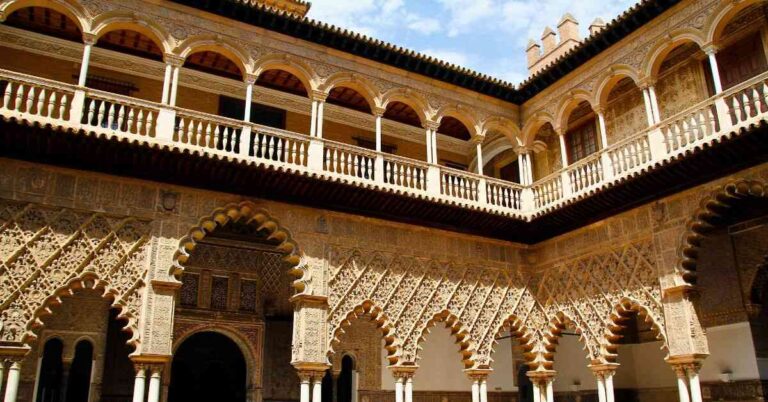
1. Inside Real Alcázar
You’ll only be able to see this one from inside the Real Alcázar.
King Pedro I, who built much of the palace, was murdered here by his brother Enrique. Locals say his ghost still lingers.
In the Patio de las Doncellas, sudden flocks of small falcons (neblíes) are seen as his sign. Some whisper of a limping step — the creak of Pedro’s injured knee echoing through the halls.
👉 Spooky Story: A night guard once told me he never lingered in the palace after hours. “Best not to turn around,” he said.

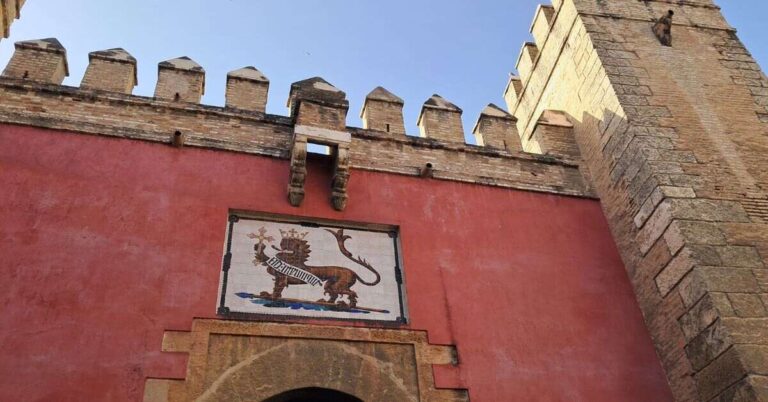
2. Patio de Banderas
The Patio de Banderas, a quiet square within Seville’s Alcázar complex, hides one of the city’s eeriest tales.
Locals whisper of strange noises, flickering lights, and the top-right window of an abandoned building that opens and closes on its own.
Some say it’s the restless spirit of a noblewoman who lived here centuries ago, mourning a lost lover. Others believe it’s simply the building remembering its haunted past. Cynics say it’s the wind.
Stand here long enough to see the shutters move and make your own mind up.

Ghostly Buildings in the City Centre: Route 3
From royal palaces, the haunted trail winds into Seville’s city centre — theatres, chapels, and noble houses that hold their own stories.
City Centre Route
- Casa Fabiola
- San Onofre Chapel
- Teatro Flamenco Sevilla
- Facultad de Bellas Artes
- Palacio de Monsalves
- Almacenes Vilima
1. Casa Fabiola
Tucked away in the old quarter, Casa Fabiola is now a museum — but some visitors report a sense of being watched as they walk its halls. The most persistent story?
A silent monk who once lived nearby and is said to drift between rooms, pausing as if listening. Exhibits may change, but the feeling of unease reportedly lingers.

2. San Onofre Chapel
This tiny, tucked-away chapel near Plaza Nueva is one of the oldest religious sites in the city still in use.
But it’s best known for an early report of a ghostly apparition — shadowy figures seen praying when the building was supposed to be empty. Locals once believed it was the soul of a priest who died during Mass and never left.
The chapel is open 24 hours a day, and anyone can enter. There’s a watchman at the door after about midnight. Please note that this is an active place of worship, so be respectful if you decide to go inside.

3. Teatro Flamenco Sevilla (ex-Teatro Quintero)
Formerly known as Teatro Quintero, this space has hosted some of Seville’s most powerful performances — and possibly some from the other side. Disembodied voices have been caught on recording equipment during rehearsals.
Staff say footsteps echo from the upper balconies, even when the theatre is locked. When I worked here, it often felt that someone was watching me. One technician said that spotlights suddenly turned on, with no one in the building.
👉 Spooky Story: A flamenco dancer once joked she wasn’t alone on stage. Even the director admitted hearing steps on the stairs when the house was empty.

4. Facultad de Bellas Artes
In this art school near the old town, creativity isn’t the only thing that stirs at night. Students speak of a cold chill in the basement corridors, where ghostly figures have been glimpsed out of the corner of the eye. Some refuse to work alone after dusk.
One graduate claimed her sketchbook went missing — and reappeared days later, with new drawings inside.
5. Palacio de Monsalves
This 19th-century palace has been abandoned and restored multiple times — but neighbours say something has always stayed behind.
At night, doors creak open by themselves, and figures are seen at upper windows, long after the building has emptied. More than one delivery driver has refused to enter after dark.

6. Almacenes Vilima (C/ Puente y Pellón)
Once a buzzing department store, Vilima had stood empty for years — but not silent. Pedestrians walking past often reported seeing movement behind the glass: shadows that shift, lights that flicker.
One nightwatchman quit after hearing voices calling his name inside. Today, the store has been converted into the H10 Casa de la Plata hotel, but some say they still hear whispers that haven’t stopped.

Triana’s Haunted Market: Route 4
Cross the Isabel II Bridge into Triana, and the atmosphere changes. The river reflects light, but the barrio feels heavier — its past darker, its stories more hushed.
Triana Route
- Isabel II Bridge (crossing into the haunted side)
- Mercado de Triana (Inquisition ruins + ghost girl)
- Callejón de la Inquisición (Inquisition gate)
1. Isabel II Bridge
According to legend, the bridge was built over the ruins of the old Inquisition prison, where countless souls met violent ends. Many of those tortured and executed were later thrown into the Guadalquivir River — right beneath where the bridge now stands.
To this day, people walking across late at night have reported hearing faint cries, prayers, and even the sound of chains rattling coming from the river below. Others claim to have seen misty human-like shapes gliding just above the water, especially on foggy winter nights.

2. Mercado de Triana
At the heart of this neighbourhood is the Mercado de Triana — one of Seville’s most vibrant food markets by day. But beneath the stalls and tiled walls lie the ruins of San Jorge Castle, once the feared headquarters of the Spanish Inquisition.
Many locals still refuse to linger here after dark. According to legend, a young girl in a white communion dress — murdered long ago — is sometimes seen wandering the corridors late at night. Some say she’s looking for her family. Others say she never left the torture chambers hidden below.
Even in daylight, workers have reported cold spots, tools being moved, and a sense of being followed through the quieter corners of the market.
👉 Spooky Story: A night security guard once admitted to me they only check certain corners of the market via camera — they’re too unnerved to go there in person.

3. Callejón de la Inquisición
Callejón de la Inquisición is one of Seville’s eeriest spots. This narrow alley tucked away between two buildings once connected the Castillo de San Jorge, the seat of the Spanish Inquisition, to the river.
Prisoners sentenced to death were marched through this passage to meet their fate.
Locals say that on quiet nights, you can still hear footsteps echoing on the cobblestones and the faint cries of those led to execution. Some even claim to see shadowy figures drifting toward the river, reliving their final walk.

Self-Guided Ghost Tour of Seville – Interactive Map
Explore this interactive map of Seville’s most haunted places — click to uncover eerie legends and ghostly hotspots around the city.

Haunted Seville FAQs
Is Seville really haunted?
Yes — ask almost any Sevillano, and they’ll say these stories are more than myths. The legends are tied to real streets, historic buildings, and local superstitions passed down for generations. Whether you believe in ghosts in Seville or not, the atmosphere is undeniable.
Can I visit haunted places in Seville at night?
Yes. Areas like Santa Cruz, Plaza Nueva, and Triana are all public spaces you can explore at night. While the Real Alcázar closes in the evening, its exterior — especially around the Patio de Banderas — is still well worth seeing after dark.
Are there ghost tours in Seville?
Yes. Several companies offer guided haunted walking tours in English and Spanish. But this article provides a DIY ghost tour of Seville, perfect for travellers who want to go at their own pace and explore more authentic stories.
Are there Halloween events in Seville?
Yes. Around Halloween, you’ll find costume parties, live music, and themed nights — especially near Alameda de Hércules, where bars and clubs join the fun. But the most unforgettable Halloween experience? Walking through Seville’s haunted legends under the October moonlight.
Have a Question?
Ask in The Seville Guide Community!
Connect with fellow travellers and locals, share tips, and get the latest insights on what’s happening in Seville.
What Will You Discover in Haunted Seville?
Seville sparkles in the sun — but it’s the night that stays with you. From Susona’s skull in Santa Cruz to the echoes of King Pedro in the Alcázar, and from ghost sightings in the city centre to whispers beneath Triana’s market, these stories reveal a city shaped by shadows.
If you’re visiting during Halloween in Seville, this self-guided ghost tour is the perfect way to celebrate — no costumes needed. Just cobblestones, candlelight, and centuries of chilling tales.
And this is just the beginning.
Keep exploring Seville’s darker (and more delicious) side:
- Watch a live show from our list of the best flamenco in Seville
- Discover tapas bars, moody rooftops, and more top things to do in Seville
- Or build your perfect spooky-season escape with our 3-Day Seville itinerary
Want more local legends and seasonal tips? Join our newsletter for insider secrets, ghostly lore, and what to see next — straight from Seville.
Because in this city, the night always has another story to tell.
Have a question? then don’t forget to join our free Facebook Group: Seville Things To Do and ask the community.
Want to discover more about Seville? then check out these other great articles to find out more.
Done-For-You Itineraries
- One Day in Seville Itinerary
- Two Days in Seville Itinerary
- Three Days in Seville Itinerary
- Five Days in Seville Itinerary
Things To See & Do In Seville
- Best Places to Watch Flamenco in Seville
- 21 Great Things to Do in Seville
- 18 Must-See Galleries and Museums in Seville
- Best Time to Visit Alcazar of Seville
- Things to Do in Seville for Free
- Best Artisan and Flea Markets in Seville
- 23 Best Day Trips From Seville
- Where’s The Nearest Beach to Seville? [Within a 2-Hour Drive]
- 34 Instagram Spots in Seville [+ Photo Location Map]
Food & Drink in Seville
- Eat Your Way Around Seville’s Top Food Markets
- Discover the Best Tapas in Triana Neighbourhood
- The Best Flamenco and Tapas Tour in Seville
- Can You Drink Tap Water in Seville?
- Where to Find the Best Breakfast in Seville
- Where to Find the Best Coffee in Seville
Seville Travel Tips
- How To Survive Seville In Summer
- Things to Do in Seville in the Rain
- What to Wear to Seville Cathedral
- What Is Seville Famous For?
- How Many Days in Seville Do You Really Need?
- How to get from Seville Airport to the City Centre
- Where to Stay in Seville, Spain: Best Neighbourhoods
- Why Visit Seville? 15 Reasons to Visit Seville