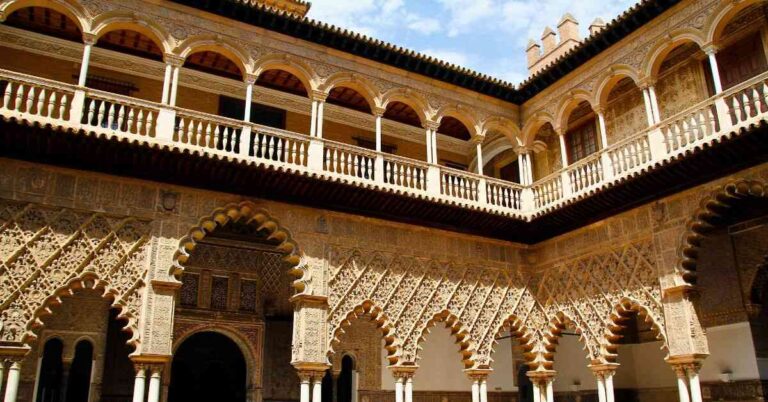
Where to Stay in Seville, Spain: 10 Best Areas & Neighbourhoods
Choosing where to stay in Seville is one of the most important decisions you’ll make when planning your trip. Get it right, and your base feels like a natural extension of the city. Get it wrong, and you could find yourself a taxi ride away from everything you actually came to see.
I’ve lived in Seville for nearly 7 years, including more than two of them in Barrio Santa Cruz itself. I know what it feels like to wake up to the bells of the Giralda, what it’s like to walk home through Triana at midnight, and which areas get genuinely loud on a Friday night.
The good news: Seville is compact.
Most of the main sights sit within a 20-minute walk of each other, which means there’s no truly bad place to stay. But your neighbourhood shapes your budget, your noise levels at night, and the version of Seville you experience every day.
Here’s a neighbourhood-by-neighbourhood breakdown of the best areas to stay in Seville, with honest advice on who each one suits and what to expect on your doorstep.
Some of the links on The Seville Guide are affiliate links. If you click through and make a purchase, we may earn a small commission. You can read our disclosure policy here. We appreciate your support, thank you.
Quick Hotel Picks in Seville
If you already have a rough idea of the kind of stay you want, these are the hotels I’d look at first:
- Best for first-time visitors: Casa 1800 Sevilla
- Best romantic stay: Hotel Las Casas de la Judería
- Best central value: Joya del Casco Boutique Hotel
- Best local-feeling stay: Hotel Ribera de Triana
- Best quiet family base: Hotel Monte Carmelo
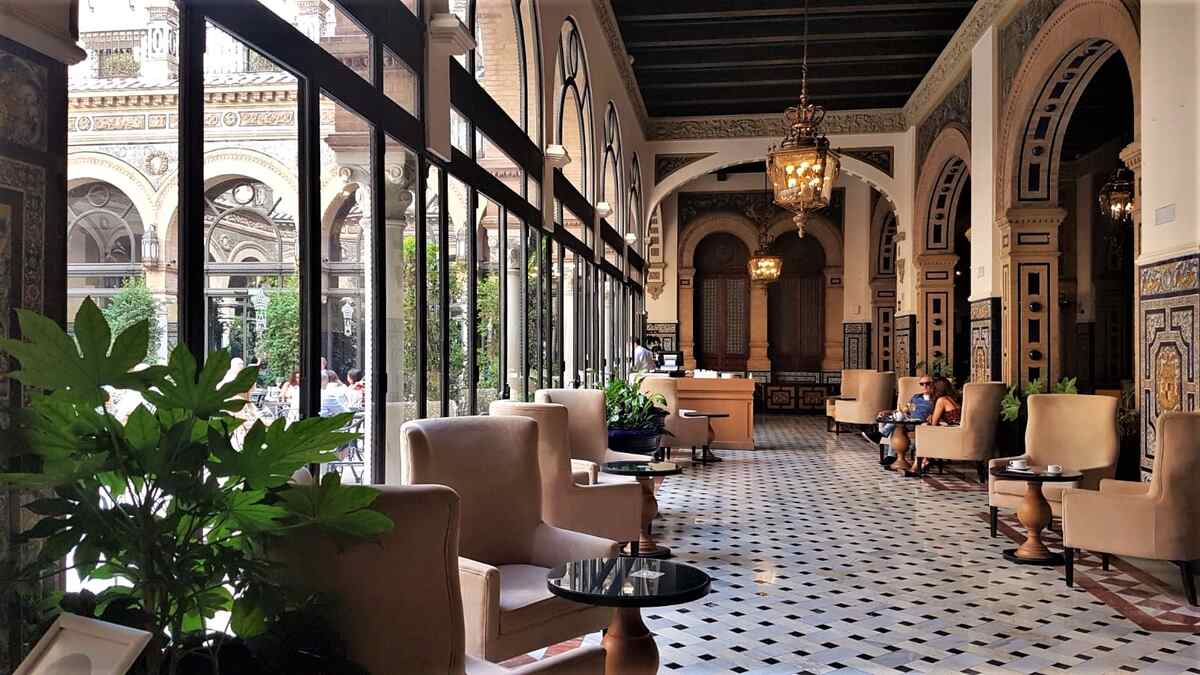
- Best splurge: Hotel Alfonso XIII
Where to Stay in Seville: Best Areas at a Glance
My top pick: If it’s your first visit to Seville, stay in Barrio Santa Cruz. It’s central, atmospheric, and puts you within minutes of the Cathedral and Alcázar, which makes sightseeing incredibly easy. El Arenal is a close second.
If you’re returning to Seville or you want a more local experience, I’d look at Barrio Alfalfa or Triana instead. Alfalfa gives you old-town charm with better food and more local life, while Triana is better if you want evenings to feel more residential and less tourist-focused.

When to book Accommodation in Seville
Seville is consistently busy between September and June. July and August are low season in Seville here due to the insane summer heat.
The absolute peak times when accommodation sells out, and the city is most crowded, are during Semana Santa (Holy Week, March or April) and Feria de Abril (two weeks after Easter); for either event, book at least three to four months ahead.
Outside these times, a few weeks’ notice is usually enough, but booking early always gives you better choices at better prices.
Have a Question?
Ask in The Seville Guide Community!
Connect with fellow travellers and locals, share tips, and get the latest insights on what’s happening in Seville.
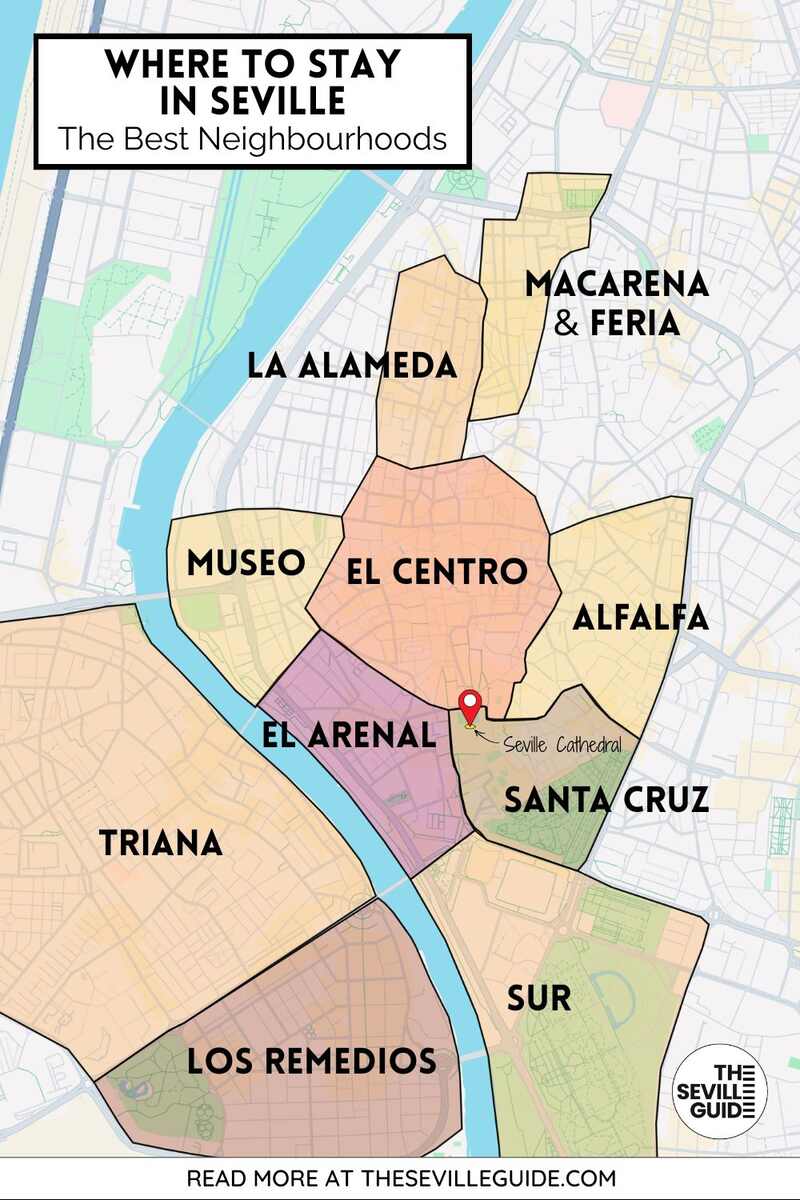
A Map of Seville’s Neighbourhoods
All the areas featured in this guide sit within or just outside the Casco Antiguo (Old Town). Most are walkable from each other, which makes it easy to explore beyond your own barrio each day.
Good To Know
Seville’s airport is around 10 km from the city centre. Find out the easiest ways to get from Seville airport to the city centre.
Seville Neighbourhoods: How They Compare
Still unsure? Here’s a quick look at how each area compares.
| Neighbourhood | Best for | Atmosphere | Walk to Cathedral | Price range |
| Barrio Santa Cruz | First-time visitors, couples | Atmospheric, historic | 5 min | High |
| Barrio Alfalfa | Repeat visitors, foodies | Lively, local | 10 min | Mid |
| El Centro | Shoppers, short breaks | Commercial, convenient | 10 min | Mid |
| Barrio Museo | Longer stays, culture | Quiet, residential | 15 min | Mid |
| El Arenal | Foodies, riverside stays | Scenic, less touristy | 10 min | Mid-High |
| Triana | Local life, flamenco fans | Authentic, vibrant | 20 min | Budget-Mid |
| La Alameda | Nightlife, vegans, LGBTQ+ | Alternative, creative | 25 min | Budget-Mid |
| Los Remedios | Families, Feria visitors | Quiet, modern | 25 min | Budget-Mid |
| Sur | Families, Plaza de España | Calm, spacious | 20 min | Mid |
| Macarena & Feria | Semana Santa, budget stays | Residential, authentic | 25 min | Budget |
Best areas to stay in Seville, by travel style.
SEVILLE ITINERARY REVIEW
Not sure if your Seville itinerary actually works?
Send us your rough plan, and we’ll check it from a local point of view.
We’ll look at timings, ticket slots, walking distances, neighbourhood order, and anything that might make your trip feel rushed or harder than it needs to be.
- Find out what to keep
- See what to swap or skip
- Fix awkward timings before you book
- Get honest local feedback by email
10 Best Areas to Stay in Seville
1. Barrio Santa Cruz
Best for: First-time visitors, couples, history lovers, and anyone who wants to be at the centre of things.
Watch out for: Higher prices, narrow streets mean cars can not enter, noise near the busier squares.
If you ask most people where to stay in Seville for the first time, Santa Cruz is the answer. It’s the historic Jewish Quarter, sitting right at the foot of the Cathedral and the Real Alcázar, and it genuinely earns its reputation.
The streets here are narrow, shaded, and strung with orange trees. Tucked-away plazas appear when you least expect them. I spent more than two years living in this neighbourhood, and the charm never wore thin.
Staying in Santa Cruz puts you within five minutes’ walk of the Cathedral, the Giralda, and the Alcázar. Most of Seville’s other main sights are within 20 minutes on foot. For a short break, the location is hard to beat.
The trade-off is price and noise. Santa Cruz is the most popular area in the city, so accommodation tends to cost more than elsewhere. Parts of it, particularly around the main tourist streets, can get loud into the early hours. If you’re a light sleeper, look for somewhere slightly off the main drag or ask about rooms facing a courtyard.
What to see nearby:
- Catedral de Sevilla and La Giralda
- Real Alcázar de Sevilla
- Jardines de Murillo
- Plaza de Santa Cruz
- Hospital de los Venerables
- Flamenco Dance Museum (Museo del Baile Flamenco)
Read More
Barrio Santa Cruz is packed with interesting things to see. Check out our in-depth guide to Seville’s most historic neighbourhood.
Places for eating and drinking:
- Bodega Santa Cruz (Las Columnas): A classic, standing-room-only tapas bar on Calle Rodrigo Caro. Order the montaditos and expect the bar to be packed.
- Cervecería Giralda: Located on Calle Mateos Gago, inside a former hammam. Has much more character than many of the tourist restaurants nearby.
- Casa Placido: On the corner of Calle Santa Teresa, a tapas bar with a good selection of tapas. If you don’t want to eat, this is a great place to stop for a vermouth.
Where to Stay in Barrio Santa Cruz
- Hotel Las Casas de la Judería: One of the most unique hotels in Santa Cruz. It’s made up of several historic houses connected by patios, corridors, tunnels, and courtyards.
- EME Catedral Hotel: A design hotel directly opposite the Cathedral, with a rooftop terrace and bar that has one of the best views in the city.
- Casa 1800 Sevilla: A boutique option in the heart of Santa Cruz with a rooftop pool and a calm, well-designed feel. Good choice for couples.
Insider Tip
The streets immediately around the Cathedral and Alcázar are the busiest. Walk five minutes deeper into Santa Cruz, towards Plaza de Santa Cruz or the Jardines de Murillo, and the atmosphere gets noticeably quieter. You’ll often find better-value accommodation in this pocket too.

Good To Know
Despite the heat, most hotels in Seville don’t have a pool, which always seems crazy, especially if you’re visiting in the summer.
If taking a dip after a day of sightseeing is on your cards, then check out our top picks for hotels with swimming pools here.
2. Barrio Alfalfa
Best for: Repeat visitors, food lovers, anyone who wants old-town character with more local life.
Watch out for: Lively on weekend evenings; slightly fewer accommodation options than Santa Cruz.
Alfalfa sits just north of Santa Cruz and shares the same old-town character, but with a younger, more local feel. It’s one of my favourite parts of the city to spend time in.
Plaza Alfalfa is the centrepiece: a square that was once a pet market and is now packed with people at almost any hour. Bar Alfalfa on the corner has become an institution. At busy times, you’ll queue for a table, and it’s standing-room only inside.
A short walk from the plaza brings you to Plaza del Pan and Plaza de la Pescadería, both good spots for people-watching. Plaza del Cristo de Burgos, a little further along, is the quieter option when you want a few minutes away from the crowds.
Alfalfa borders Soho Benita, a pocket of the city with independent shops, galleries, and a noticeably creative energy. Just nearby, Casa de Pilatos is one of Seville’s great under-visited palaces. It’s nearly as impressive as the Alcázar, far less crowded, and well worth an afternoon.
What to see nearby:
- Casa de Pilatos
- Plaza Alfalfa
- Plaza del Pan and Plaza de la Pescadería
- Metropol Parasol (Las Setas) is a short walk north
- Palace of the Countess of Lebrija (Palacio de la Condesa de Lebrija)
Good for eating and drinking:
- Bar Alfalfa: The neighbourhood institution. Order the flamenquín and expect a wait at weekends.
- La Bodega de la Alfalfa: A good traditional option just off the main plaza for wine and tapas.
- Petra: Long-established family-run restaurant, serving up classic Andalucian dishes since the 1940s.
Where to Stay in Alfalfa
- H10 Casa de la Plata: A well-located contemporary hotel close to the main square, with good reviews and a rooftop pool.
- Joya del Casco Boutique Hotel: A solid mid-range boutique option in the historic centre, well-priced for the quality.
Don’t Miss
Casa de Pilatos is one of the best things to see in Seville, and most first-time visitors walk straight past it. If you’re staying in Alfalfa, it’s right on your doorstep. The queues are a fraction of what you’d face at the Alcázar, and the building is extraordinary.

3. El Centro
Best for: Short visits, shopping, and anyone who wants a central base with good transport access.
Watch out for: Less character than Santa Cruz or Alfalfa; feels more commercial than neighbourly.
El Centro stretches from Puerta Real in the south to Puerta Osario in the north and is the commercial heart of the city. Calle Sierpes and Calle Tetuan are the main shopping streets, running parallel to each other through the centre.
You’ll find Spanish high-street chains alongside traditional shops selling fans, ceramics, and flamenco wear.
The neighbourhood is also home to the ornate Ayuntamiento (Town Hall) and the Iglesia Colegial del Divino Salvador. The church tends to get overlooked, which is a shame as it’s genuinely impressive inside.
El Centro generally offers a wider range of accommodation at slightly lower prices than Santa Cruz, with good transport connections.
It’s a practical choice if you’re visiting for a short break and want to be central without paying Santa Cruz prices. The atmosphere is more commercial than neighbourly, but the location works well.
What to see nearby:
- Metropol Parasol (Las Setas de Sevilla)
- Iglesia Colegial del Divino Salvador
- Ayuntamiento de Sevilla
- Plaza de la Encarnación
- Archivo General de Indias (short walk south)
Good for eating and drinking:
- Ovejas Negras: A popular spot for creative tapas just off Calle Sierpes. Reliable and consistently good.
- Tradevo Centro: A great option if you’re looking for excellent fish dishes in the neighbourhood for a slightly more relaxed lunch or dinner.
Where to stay in El Centro
- Querencia de Sevilla: A stylish boutique hotel with a rooftop that has excellent views over the city.
- Hotel Inglaterra: A classic option on Plaza Nueva, well located and with a long history in the city.
Good To Know
For a city that reaches insane temperatures during the summer, it’s always surprising how few accommodations have swimming pools, so we did the work for you and handpicked our favourite hotels in Seville with a pool.

4. El Arenal
Best for: Foodies, couples, anyone wanting a riverside location close to the main sights with slightly less tourist pressure than Santa Cruz.
Watch out for: Still a popular tourist area; quieter than Santa Cruz in the evenings, which suits some visitors and not others.
El Arenal runs along the left bank of the Guadalquivir River, from the Cathedral down to the Torre del Oro. It’s slightly less trodden compared to Santa Cruz but just as well placed, and often better value.
This was historically Seville’s port district, which explains the mix of civic architecture and maritime heritage. Today, it’s one of the best areas in the city for tapas, with a good density of local restaurants and several excellent boutique hotels.
The Hospital de la Caridad is here: a Baroque hospital turned art gallery with a collection that most visitors entirely overlook. So is the Plaza de Toros, Spain’s oldest bullring, and the Torre del Oro with its views over the river.
The semi-circular Plaza del Cabildo, tucked just off the main street, is one of the most photogenic places in the city, which most visitors walk past without realising it exists.
What to see nearby:
- Torre del Oro
- Hospital de la Caridad
- Plaza de Toros de la Real Maestranza
- Plaza del Cabildo
- Paseo de Cristóbal Colón (riverside promenade)
Good for eating and drinking:
- Islamorada Tapas Bar: Popular restaurant, mixing traditional Andalusian tapas with dishes that have a more international edge. The truffle tortilla is the standout dish, and the terrace is a good spot on a warm evening. Book ahead; it fills up fast.
- Bodega Díaz-Salazar: A proper old-school bodega on Calle García de Vinuesa, in business since 1908. Come for the wine served straight from the barrel, including more than 40 varieties mostly from the Sherry Triangle. The tapas are traditional and good value. A much more local feel than most places in the area.
Where to Stay in El Arenal
- Hotel Adriano Sevilla: A boutique hotel in a renovated 18th-century building in the historic centre. It has a calm, well-kept feel that’s a good fit if you want somewhere characterful without the noise of the busier tourist streets.
- Hotel Lobby Room Sevilla: A 5-star option with a strong sense of design and a prime location close to the main landmarks. The interiors lean towards contemporary art and modern styling, which makes it stand out from the more traditional options in the area.
Feeling Hungry?
For a good tapas crawl from El Arenal, start at the riverfront bars on Paseo de Cristóbal Colón and work back towards the Cathedral. You’ll pass some reliable spots that don’t appear on any “best of” list.

5. Sur (Plaza de España Area)
Best for: Families, anyone who wants to be near Plaza de España, and visitors who prefer a calmer base at night.
Watch out for: Further from the Old Town tapas scene; public transport helps reach other parts of the city.
The Sur district sits south and east of the Casco Antiguo and is dominated by two things: the Plaza de España and the Parque de María Luisa.
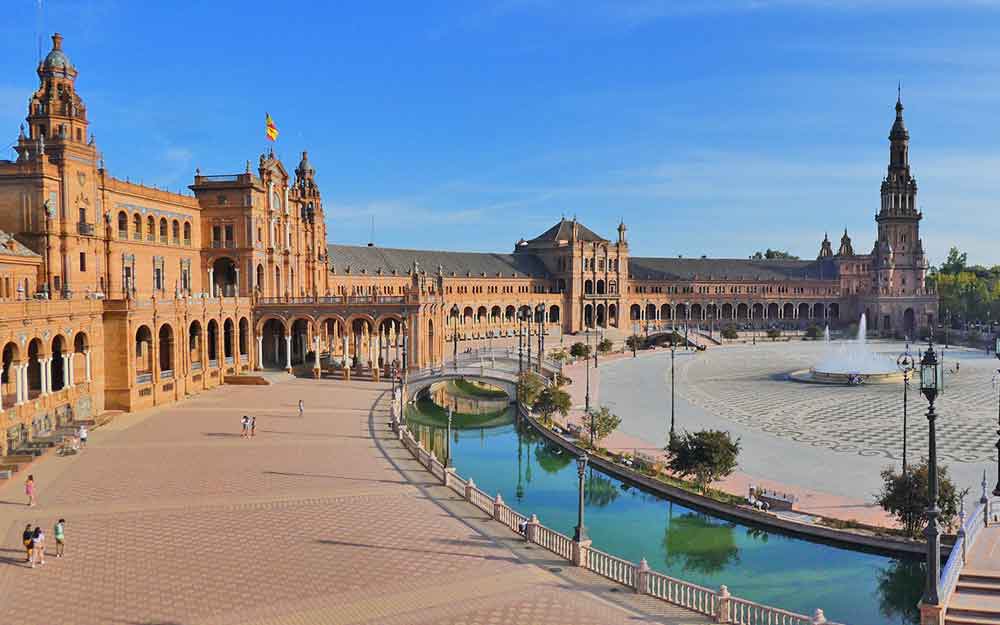
The Plaza de España was built for the 1929 Ibero-American Exposition and is one of the most photographed places in the city. The sweeping semi-circular square is lined with tiled alcoves representing each Spanish province, and there are boats for hire on the small canal that runs through it.
Staying nearby means you can visit early in the morning, well before the tour groups arrive, which is the only way to really appreciate it. Here you’ll find the Alfonso XIII, one of the most iconic luxury hotels in Seville.
The Parque de María Luisa is adjacent: large, shaded, and home to the Museo de Artes y Costumbres Populares as well as the Acuario de Sevilla.
The former Fábrica de Tabacos (Tobacco Factory), now part of the University of Seville, is also close by. This 18th-century building was the inspiration behind Bizet’s opera Carmen.
Nights in the Sur district tend to be quieter than in the Old Town, which makes it a sensible choice for families. Transport links are good, and the park and the plaza give you excellent daytime options on your doorstep.
What to see nearby:
- Plaza de España
- Parque de María Luisa
- Museo de Artes y Costumbres Populares
- Acuario de Sevilla (Aquarium)
- Antigua Fábrica de Tabacos (now University of Seville)
Good for eating and drinking: The immediate area around Plaza de España has restaurants and cafés, but quality is variable. Walk towards the Barrio Santa Cruz or El Arenal for better options. The neighbourhood itself is not a dining destination.
Where to Stay in Sur
- Hotel Alfonso XIII: Seville’s most famous hotel, positioned between the Alcázar and Parque de María Luisa. A Marriott Luxury Collection property with a stunning Moorish-influenced interior. If budget allows, it’s one of those hotels that’s genuinely worth experiencing. If the budget doesn’t allow, then book their Sunday brunch instead!
6. Triana
Best for: Repeat visitors, anyone after a local feel, flamenco enthusiasts, people staying more than a few days.
Watch out for: Longer walk to the major tourist sights; more limited hotel accommodation than in the historic centre.
Triana sits on the west bank of the Guadalquivir, connected to the city centre by the Isabel II bridge (known locally as the Triana bridge) and Puente de San Telmo. It’s the neighbourhood I most often recommend to anyone who wants a genuinely local experience, and that reputation is earned.
This is where flamenco has deep roots in Seville. The traditional tile workshops along the streets near the Mercado de Triana are still partly operational, and Calle Betis along the riverbank is one of the best streets in the city for an evening out.
The views back across the river towards the Old Town are excellent from almost anywhere along here.
Triana has a proper neighbourhood feel: you’ll eat better for less money, and the bars cater to residents as much as visitors. It’s the kind of place that rewards spending a few days rather than just an afternoon.
The practical consideration is distance. The Cathedral is around a 25-minute walk from most parts of Triana. That works well for a longer stay, but it’s worth knowing if you’re planning to visit the main sights every single day of a short trip.
What to see nearby:
- Mercado de Triana
- Centro Cerámica Triana (ceramics museum and workshop)
- Calle Betis (riverside bar street)
- Capilla de los Marineros
- Castillo de San Jorge (at the foot of the bridge)
Good for eating and drinking:
- Las Golondrinas: An iconic Triana tapas bar that’s been going for over 50 years. The ground floor is a traditional stand-at-the-bar experience, while upstairs you can sit down for larger raciones. Popular with locals and well worth the visit for the atmosphere alone.
- Típico Barra de Tapas: On the corner of Pagés del Corro and San Jacinto, this spot has the feel of a proper Triana bar, decorated with traditional azulejos tiles. Bar service only, no table service, which keeps things authentic and unpretentious.
Where to Stay in Triana
- Hotel Ribera de Triana: Top-rated 4-star hotel right next to the Triana Bridge on the riverfront. Recently renovated, with spacious modern rooms and a rooftop terrace and pool that looks back across the river towards the Torre del Oro and the Cathedral. Worth requesting a river-view room.
- Hotel Zenit Sevilla: A reliable 4-star option in Triana with large rooms, wooden floors, and Andalusian ceramic tiling in the bathrooms. There’s a rooftop bar and a small pool. Good value for the standard, and well placed for exploring Triana’s bar and restaurant scene on foot.

7. Barrio Museo
Best for: Longer stays, art lovers, convenience to Plaza de Armas bus station, central base away from busy areas.
Watch out for: Fewer hotel options than other areas; quieter neighbourhood with less going on in the evenings.
Barrio Museo is one of the most overlooked areas on this list, and one that’s worth knowing about. It sits just west of El Centro, between the historic centre and the river, and takes its name from the Museo de Bellas Artes, one of the best art museums in Andalusia and frequently skipped in favour of the bigger ticket sights.
This is a quieter, more lived-in neighbourhood than Santa Cruz or Alfalfa. You’re still within a comfortable 15-minute walk of the Cathedral, but the streets feel significantly less tourist-heavy. If you want to be central without being in the thick of it, Museo is worth considering.
The neighbourhood also sits close to the Plaza de Armas bus station, which makes it practical if you’re arriving by long-distance bus from other cities in Andalusia.
What to see nearby:
- Museo de Bellas Artes de Sevilla
- Plaza del Museo
- Old Plaza de Armas Train Station
- Iglesia de la Magdalena
Good for eating and drinking:
- Mercado del Barranco: A covered food market in a restored 19th-century iron and glass building near the Triana bridge. Good for grazing through different stalls rather than a sit-down meal.
- Billy Brunch: A solid option for breakfast and brunch if you’re looking for something that’s not a tostada.
Where to stay in Barrio Museo
- Hotel NH Seville Plaza de Armas: A well-located hotel close to the Plaza de Armas bus station and within walking distance of the historic centre. A practical, reliable choice if you’re arriving by coach or want easy road access.

8. La Alameda de Hércules
Best for: Nightlife seekers, LGBTQ+ travellers, vegetarians and vegans.
Watch out for: Can be noisy at night; slightly longer walk to the main sights.
Alameda, as everyone calls it, is the most alternative of Seville’s central neighbourhoods. It sits between La Macarena and the river, centred on one of Europe’s oldest public promenades and flanked by Roman columns at both ends.
In recent years, it’s become the hub for Seville’s LGBTQ+ community, independent music venues, and younger visitors looking for something beyond the tourist trail. The bar scene runs late and covers a wide range: live music, tapas bars, craft beer, and everything in between.
Alameda is also the best area in Seville for vegetarians and vegans. The historic centre can be genuinely difficult if you don’t eat meat. Alameda has a cluster of plant-forward restaurants and organic cafés that make eating well much easier.
The neighbourhood is about a 20-minute walk from the Cathedral. It’s still central, but not on the doorstep of the main sights in the way that Santa Cruz or Arenal are.
What to see nearby:
- The Alameda promenade itself, with Roman columns at each end
- Regular artisan and flea markets on the promenade
- Easy walking distance to Macarena and Barrio Museo
Good for eating and drinking:
- Arte y Sabor: My go-to for plant-based food in Seville. Good menu, good value, genuinely creative.
- Duo Tapas: Another excellent vegetarian and vegan-friendly option nearby.
- Corral de Esquivel: A classic taberna and one of the better bars on the promenade for a relaxed afternoon drink in the sun.
Where to Stay in La Alameda
- Hotel Casa Palacio Don Ramón: A boutique hotel on the edge of the Alameda neighbourhood, built in a converted palacio with Andalusian details throughout. A good option if you want somewhere with character at a mid-range price.

9. Macarena & Feria
Best for: Anyone wanting an authentic neighbourhood feel, budget-conscious travellers, visitors arriving by car.
Watch out for: Longer walk to the Cathedral and Alcázar; quieter evenings unless you head to Alameda.
Macarena sits north of the city centre and has a genuinely residential feel. It’s the choice for anyone who wants to see the real Seville rather than the tourist-facing version of it.
The neighbourhood is best known for the Basílica de la Macarena, home to La Virgen de la Esperanza Macarena, one of the city’s most venerated religious icons.
During Semana Santa (Holy Week), the streets here fill with thousands of people watching the processions. If you’re visiting for Easter, particularly in March or April, basing yourself in Macarena puts you close to some of the most moving scenes of the week.
Macarena is also within comfortable walking distance of La Alameda de Hércules, which means you get a local, residential feel with easy access to one of Seville’s liveliest bar areas. Accommodation here is generally cheaper than in the historic centre.
What to see nearby:
- Basílica de la Macarena
- Murallas de Sevilla (old city walls, still standing along this edge of the city)
- Mercado de Feria (local street market)
Good for eating and drinking:
- El Rinconcillo: Reportedly the oldest bar in Seville, dating back to the 17th century. Worth the visit for the atmosphere alone, not just the tapas.
Where to Stay in Macarena
- Alcoba del Rey de Sevilla: A boutique hotel close to the Basílica de la Macarena and directly opposite the Andalusian parliament. There’s a rooftop terrace with a hot tub, and some suites have a private spa bath. The Cathedral and Plaza de Toros are around a 20-minute walk, and La Alameda de Hércules is only three minutes away on foot.

10. Los Remedios
Best for: Families, longer stays, access to Feria de Abril, and anyone who prefers a quieter and less touristy base.
Watch out for: Further from the main sights; you’ll rely on walking or public transport to reach most attractions.
Los Remedios is a modern, residential neighbourhood on the west bank of the Guadalquivir, just south of Triana. It’s the least touristy area on this list, which is precisely its appeal for some people.
Parque de los Príncipes is the main draw within the neighbourhood: a shaded green space with a lake, well-suited to an afternoon of rest after a day of sightseeing. Accommodation here tends to be good value, and the dining options are local rather than tourist-facing.
Los Remedios is also where the Feria de Abril takes place each spring, typically two weeks after Semana Santa. The fairground is set up here each year, which means staying in this area puts you right on the doorstep of the celebrations. If you’re visiting for the Feria, book as far in advance as possible. Prices rise sharply, and accommodation fills up months ahead.
What to see nearby:
- The Real de la Feria (Feria de Abril fairground, April or May)
- Parque de los Príncipes
- Easy access to Triana and the historical centre on foot
Good for eating and drinking: The dining options in Los Remedios are local neighbourhood spots rather than destination restaurants. You’ll find a good selection around the main avenues, but this area is more about living like a local than following a food guide.
Where to Stay in Los Remedios
- Hotel Monte Carmelo: A mid-range option well placed for both Los Remedios and the wider city, around 15 minutes’ walk from major landmarks. One practical plus: private underground parking available on reservation, which makes it a solid choice if you’re arriving by car.
- Eurostars Guadalquivir: A comfortable hotel with spacious, soundproofed rooms and plenty of facilities. Around a 15-minute walk from the Triana Bridge.

Where to Stay in Seville for the First Time
If this is your first trip and you’re not sure where to start, base yourself in Barrio Santa Cruz or El Arenal.
Both areas put you within easy walking distance of the Cathedral, the Alcázar, and the Giralda. You’ll find the widest range of accommodation, plenty of restaurants at different price points, and no need for taxis or buses to reach the main sights.
Santa Cruz has more atmosphere but also higher prices and more tourists. El Arenal is often a better value, slightly calmer, and still very well placed for sightseeing.
Barrio Alfalfa is worth considering if you’re staying for four or more days. You get the same old-town character but with more local life, and it’s only five minutes’ walk from Santa Cruz.

A note on timing
If you’re visiting in spring, particularly around Semana Santa or Feria de Abril, book accommodation as far in advance as possible. Both periods see high demand across the city, prices rise significantly, and the best places sell out months ahead.
Are There Any Areas to Avoid in Seville?
In the historic centre, I’ve never had a problem in six-plus years of living here. The same goes for most of the city. Seville is genuinely safe, and the neighbourhoods covered in this guide are all fine for visitors, including at night.
That said, like any city, there are a handful of areas on the outskirts that locals would steer clear of. Two that sometimes come up are Los Pajaritos, to the east of the city and Las 3000 Viviendas, to the southeast.
These are residential areas with longstanding social challenges, and they do have a different character from the rest of Seville. But as a visitor, you’d have no reason to go near either of them. They’re not on the route to any tourist sight, any restaurant worth visiting, or anything else you’d realistically find yourself heading to.
The one genuine thing to be aware of anywhere in Seville is pickpocketing in very crowded spots.
The streets immediately around the Alcázar and Cathedral have the highest volume of visitors at any one time, which makes them the most active areas for petty theft. Keep an eye on bags and pockets in those spots, particularly when it’s busy.
Beyond that, use the same common sense you would in any unfamiliar city, and you’ll be fine.

Best Area to Stay in Seville FAQs
What is the best area to stay in Seville, Spain?
The best area to stay in Seville is the Casco Antiguo (Old Town), particularly Barrio Santa Cruz or Barrio Alfalfa. Both are central, walkable, and close to the main attractions. First-time visitors generally do best in Santa Cruz for its location and atmosphere. Repeat visitors often prefer Alfalfa or Triana for a more local feel.
Which Seville neighbourhood is closest to the main tourist sights?
Barrio Santa Cruz and El Arenal are the closest to the Cathedral, the Alcázar, and the Giralda. All the other central neighbourhoods listed here are within a 10 to 20-minute walk of the main sights. Seville is compact enough that proximity to attractions does not have to be your only consideration when choosing where to stay.
Where to stay in Seville for the first time?
For a first visit, Barrio Santa Cruz or El Arenal are the safest choices. Both put you at the heart of the city within easy walking distance of every major sight. If you’re staying for four or more days, Barrio Alfalfa is also worth considering for its combination of old-town character and local life.
Where to stay in Seville with a family?
The Sur district, near Plaza de España and Parque de María Luisa, is a good option for families. Nights are quieter than in the Old Town, the park offers plenty of space, and the main sights are reachable on foot or by public transport. El Arenal is another good option, with a central location and a slightly calmer feel than Santa Cruz.
Where to stay in Seville for nightlife?
La Alameda de Hércules is the best neighbourhood for nightlife in Seville. It has the widest range of bars, live music venues, and late-night options, with something for most tastes. Triana is also popular for evenings out, particularly along Calle Betis for a more traditional bar scene with views across the river.
Where to stay in Seville for a romantic break?
Barrio Santa Cruz is the natural choice for a romantic trip. The narrow streets, hidden plazas, and proximity to the city’s most beautiful landmarks make it well-suited to couples. Barrio Alfalfa has a similar atmosphere with a slightly more intimate, less touristy feel.
Where to stay in Seville with a car?
If you’re arriving by car, look for accommodation in the Macarena neighbourhood or near the Plaza de Armas bus station. Both areas have better access to major roads and more realistic parking options than the historic centre. Driving into the Old Town is genuinely difficult: many streets are one-way or pedestrianised, parking is almost non-existent, and fines are common.
Where to stay in Seville without a car?
Anywhere in the central neighbourhoods listed here. Seville is one of the most walkable cities in Spain, and the main sights sit close together. The city also has a tram, a metro, and a well-used bike-sharing scheme for longer journeys.
Have a Question?
Ask in The Seville Guide Community!
Connect with fellow travellers and locals, share tips, and get the latest insights on what’s happening in Seville.
Keep Planning Your Seville Trip
Wherever you stay in Seville, you won’t be far from the main things to see. The city is compact, walkable, and easy to explore on foot, especially if you choose one of the neighbourhoods in this guide.
If you want to stay close to the action on your first trip, you won’t go wrong with Barrio Santa Cruz. If you want something a little more local, Alfalfa, Triana, or Alameda are all good alternatives.
Ready to plan the next step? Start here:
- Discover the top things to see in Barrio Santa Cruz
- Read our guide to the best hotels in Santa Cruz
- Browse the best hotels in Seville with swimming pools
SEVILLE ITINERARY REVIEW
Not sure if your Seville itinerary actually works?
Send us your rough plan, and we’ll check it from a local point of view.
We’ll look at timings, ticket slots, walking distances, neighbourhood order, and anything that might make your trip feel rushed or harder than it needs to be.
- Find out what to keep
- See what to swap or skip
- Fix awkward timings before you book
- Get honest local feedback by email
Have a question? then don’t forget to join our free Facebook Group: Seville Things To Do and ask the community.
Want to discover more about Seville? then check out these other great articles to find out more.
Done-For-You Itineraries
- One Day in Seville Itinerary
- Two Days in Seville Itinerary
- Three Days in Seville Itinerary
- Five Days in Seville Itinerary
Things To See & Do In Seville
- Best Places to Watch Flamenco in Seville
- 21 Great Things to Do in Seville
- 18 Must-See Galleries and Museums in Seville
- Best Time to Visit Alcazar of Seville
- Things to Do in Seville for Free
- Best Artisan and Flea Markets in Seville
- 23 Best Day Trips From Seville
- Where’s The Nearest Beach to Seville? [Within a 2-Hour Drive]
- 34 Instagram Spots in Seville [+ Photo Location Map]
Food & Drink in Seville
- Eat Your Way Around Seville’s Top Food Markets
- Discover the Best Tapas in Triana Neighbourhood
- The Best Flamenco and Tapas Tour in Seville
- Can You Drink Tap Water in Seville?
- Where to Find the Best Breakfast in Seville
- Where to Find the Best Coffee in Seville
Seville Travel Tips
- How To Survive Seville In Summer
- Things to Do in Seville in the Rain
- What to Wear to Seville Cathedral
- What Is Seville Famous For?
- How Many Days in Seville Do You Really Need?
- How to get from Seville Airport to the City Centre
- Where to Stay in Seville, Spain: Best Neighbourhoods
- Why Visit Seville? 15 Reasons to Visit Seville