
Maximizing Your 5 Days in Seville: 2025 Travel Guide
If you’re planning to spend 5 days in Seville, you’re in the right place to get some first-hand advice.
I live in Seville and over the years have spent plenty of time getting to know the ins and outs of this beautiful city.
This guide is packed with insider tips to help you make the most of your visit. From the iconic sites to hidden gems, this Seville 5 day itinerary will help you experience the city like a local.
Whether you visiting Seville as part of a longer trip around Andalucia, or you’re on a short city break, let’s get into what to do in Seville in 5 days.

Some of the links on The Seville Guide are affiliate links. If you click through and make a purchase, we may earn a small commission. You can read our disclosure policy here. We appreciate your support, thank you.
5 Day Seville Itinerary: Day-By-Day Overview
Day 1: Arrival day, Plaza de España, Parque de María Luisa, Barrio Santa Cruz, , Churros y Chocolate at Bar El Comercio
Day 2: Real Alcázar, Seville Cathedral and La Giralda, Archivos de Indias, Torre de Oro watch a Flamenco Show and Bar El Rinconcillo
Day 3: Explore Triana, Casa De Pilatos, Palacio de las Dueñas, City Museums, Sunset Cruise on the Guadalquivir River
Day 4: Day trip from Seville. Opt for Italica, Córdoba, Cadiz, Gibraltar, Granada or Ronda
Day 5: Discover off-the-beaten-track places in Cartuja, Souvenir Shopping in Calle Sierpes, Markets and Triana, Metropol Parasol (Las Setas) Light Show and Rooftop Bars
Best Recommended Tours
- Early Access for Real Alcazar
- Seville Tapas and Traditions Food Tour
- Early Access for Royal Alcazar, Seville Cathedral & Giralda and Barrio Santa Cruz Tour
Have a Question?
Ask in The Seville Guide Community!
Connect with fellow travellers and locals, share tips, and get the latest insights on what’s happening in Seville.
Map for 5 Day Seville Itinerary
Here are all the locations I talk about in this article. Click on the map to access the interactive version.

Looking for a Different Length Itinerary for Seville?
If you’re still planning your trip and not sure how long to spend in Seville? Check out these other Seville itinerary variations.
- Seville 1 Day Itinerary
- Seville 2 Day Itinerary
- Seville 3 Day Itinerary
- Seville 4 Day Itinerary
SEVILLE ITINERARY REVIEW
Not sure if your Seville itinerary actually works?
Send us your rough plan, and we’ll check it from a local point of view.
We’ll look at timings, ticket slots, walking distances, neighbourhood order, and anything that might make your trip feel rushed or harder than it needs to be.
- Find out what to keep
- See what to swap or skip
- Fix awkward timings before you book
- Get honest local feedback by email
Practical Information for Visiting Seville
Getting to Seville
Getting to Seville is quite straightforward, thanks to its well-connected transportation options.
You can fly directly into Seville Airport (SVQ). The airport is located about 10km outside of the city. But there are plenty of Seville airport transfer options to get you to the centre easily.
Alternatively, the city is easily accessible by high-speed train from major Spanish cities like Madrid and Barcelona. Santa Justa is located about 1.5km from the centre.
There are also regular bus services. Buses arrive at Plaza de Armas.
Getting Around Seville
Seville is an incredibly walkable city, with most major attractions within easy reach on foot.
Seville’s public transport is also cheap and reliable. You can use the local bus and tram service
Biking is another great option, thanks to Seville’s extensive network of bike lanes.
There are also plenty of taxis and ride-sharing services.
Siesta Times
It wasn’t until I moved to Seville, that I appreciated their tradition of the siesta. This is typically from around 2 pm to 5 pm. During these hours, some shops, restaurants, and businesses close.
Where to Stay in Seville
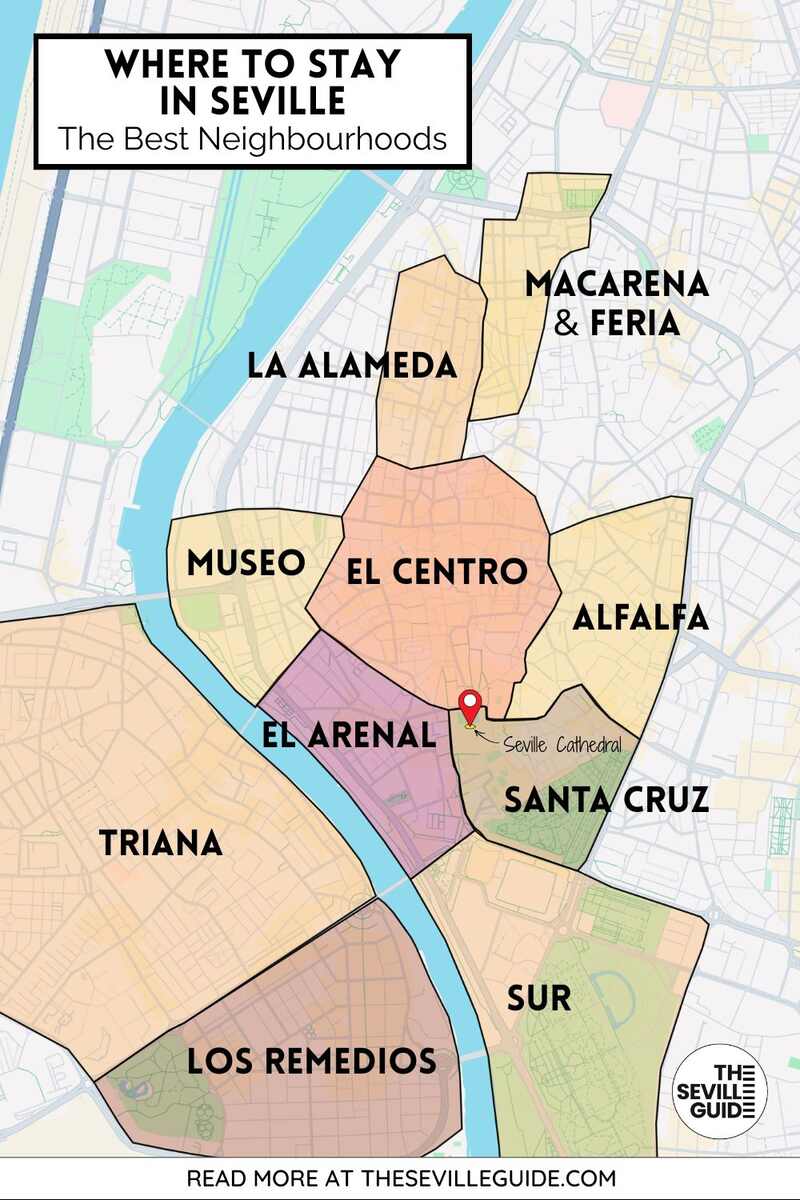
For convenience, I recommend staying in the Santa Cruz neighbourhood, although, for a more local experience, Triana is another great option and a little calmer.
Overall, it’s safe for tourists in Seville in the main neighbourhoods shown on the map.
I recommend checking out these two places:
- If you want to splurge a little, I suggest staying at Seville’s famous Hotel Alfonso XIII.
- For something a little more budget-friendly, then EME Sevilla Turistica is a great option.
Find out other great neighbourhoods to stay in Seville.
How to Spend 5 Days in Seville
5 Days in Seville: Day 1
Day 1 Morning: Arrival and Settling In
Your first day in Seville is fairly relaxed.
Plan to arrive in the morning and check into your accommodation. Most hotels will hold your luggage if your room isn’t ready. Alternatively, there are several luggage store shops around the city where you can store your bags.
After dropping off your stuff, find something to eat. There are plenty of great breakfast spots in Seville serving up everything from traditional Spanish breakfasts to your hipster-style avocado-on-toast joints.
One thing I do recommend, at least once during your trip to Seville, is to try churros y chocolate – a long fried stick of batter dipped in a thick gooey chocolate sauce.
Ignore the calorie count on this Spanish classic.
One of the best places I tell everyone to try this sweet treat is Bar El Comercio. This iconic bar has been around since 1904 – the decor doesn’t look like it’s been updated since then either.
You’ll often have to queue to get a table, although they do have a takeout option if you don’t want to wait.
Bar El Comercio Location: C. Lineros, 9, Casco Antiguo, 41004 Sevilla

Day 1 Afternoon: Plaza de España and Parque de María Luisa
Plaza de España
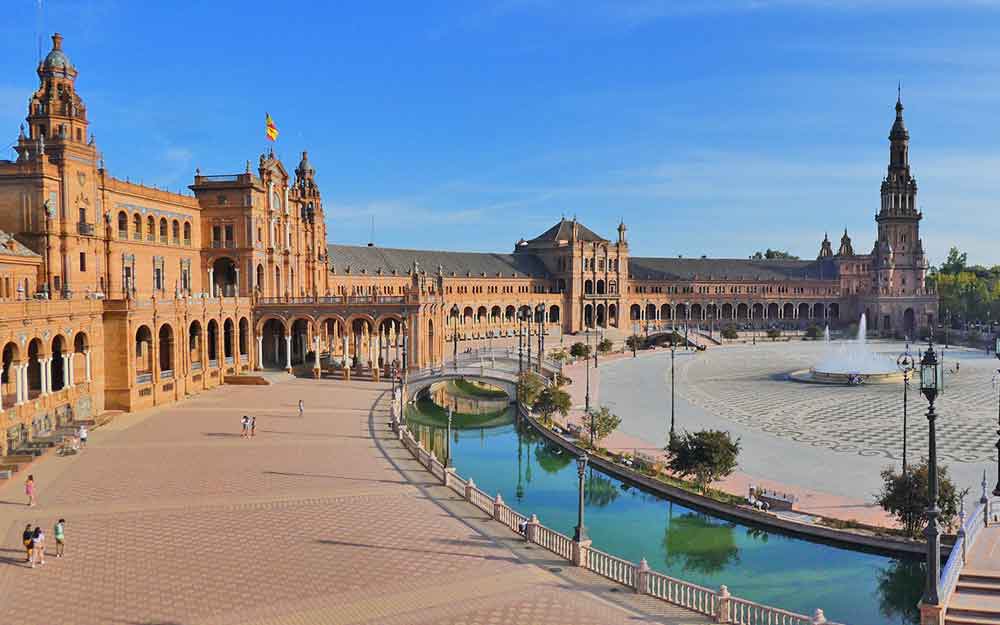
This stunning semi-circular plaza is one of the most iconic landmarks in Seville if not Spain! I never tire of visiting this place.
The plaza was built in 1929 as part of the Ibero-American Exhibition. It’s lined with impressive towers and balconies on top of an alcoved walkway. A moat runs parallel to the buildings with several decorative bridges crossing it.
On the inner edge of the plaza you’ll find colourful tiled benches and scenes each representing 48 provinces that Spain had at the time – today there are 50 different provinces.
You’ll often find flamenco performances happening under the central tower which gathers a crowd, and street entertainers near the central fountain. Although slightly kitsch, you can rent a rowing boat to paddle around the moat.
Plaza de España has also been used in several films, one of the most famous is “Star Wars: Episode II: Attack of the Clones”.
Top Things To Do at Plaza de España
- Explore the tiled alcoves
- Row a boat
- Visit the Military History Museum
- Watching the impromptu flamenco shows
Plaza de España Location: Plaza de España, s/n. 41013 Sevilla
Parque de María Luisa
Right next to Plaza España, you’ll find the best park in Seville. The expansive Maria Lusia Park has over 100 acres of beautiful gardens.
You’ll find everything from gazebos and lakes to museums among tropical trees. It’s a popular place for locals and tourists, with plenty of pathways and benches under the shade.
Top Things To Do at Parque de María Luisa
- Go up El Monte Gurugú
- Explore the pavilions
- Spot the colony of green parrots (you’ll probably hear them before you see them!)
- Visit the Museo de Artes y Costumbres
Parque de María Luisa Location: P.º de las Delicias, s/n, 41013 Sevilla
Good to know: Plaza de España and Parque de María Luisa is close to the Guadalquivir River. There are lots of great places to eat and drink here.
One of my favourite places is Maquiavelo. This restaurant/bar is particularly good in the evenings when they bring out fire dancers and have a live DJ! Check the opening times before you visit. It’s mostly an outdoor venue so isn’t open all year round.

Day 1 Evening: Explore Santa Cruz and Its Tabernas
Barrio Santa Cruz is the old Jewish Quarter in Seville. It’s also one of my favourite parts of the city partly because I lived in this neighbourhood for a few years. I would often take daily walks purposely getting lost in the labyrinth-like alleyways.
The streets here are narrow and winding and packed with history. Colourful houses line the cobble-stoned alleyways opening up into fountain-filled courtyards.
Spend the evening wandering around this area, stopping off at the traditional tavernas and trying local tapas and wine.
Although you can easily explore the neighbourhood on your own, it’s worth taking a guided tour to hear some great stories and learn more about the history of one of the oldest parts of Seville.
Barrio Santa Cruz Location: The area between the Cathedral, and Jardines de Murillo
Good to know: Evenings in Seville are fairly drawn out – the locals don’t usually eat their evening meal until about 9 or 10 pm. Don’t be surprised if some restaurants aren’t serving food until closer to this time.

5 Days in Seville: Day 2
Day 2 Morning: Visit the Real Alcázar
Start your day early at the Real Alcázar of Seville, the stunning royal palace known for its intricate plasterwork and well-manicured gardens.
Originally a fort during Seville’s Arabic rule, it has seen centuries of transformation under both Christian and Spanish kings, evolving into the architectural wonder you see today. In 1987, it earned a spot as a UNESCO World Heritage site.
The palace features Mudéjar style – which is a blend of Arabic and Christian styles. You’ll find colourful tiles and intricate plasterwork making it one of Seville’s most photographed sites.
Make sure to visit the Hall of Ambassadors (Salon de los Embajadores), Courtyard of the Maidens (Patio de las Doncellas) and Levies Courtyard (Patio de Leviés).
Another of my favourite places here is the underground baths.
Good to know: The Royal Alcazar is one of Seville’s most visited attractions and gets insanely busy. There are only a limited number of tickets available per day, and they often sell out. As soon as you know your travel dates, I recomend booking Alcazar tickets.
Want to avoid the crowds? Then visit the Alcazar on an early access tour!
Tips for Visiting the Alcazar
- Book Tickets in Advance: Skip the long lines by purchasing your tickets online.
- Visit Early in the Morning: Avoid crowds by going right at opening time.
- Don’t Rush: There’s so much detail to take in. Allow at least 2 hours, or more, to appreciate its gardens, architecture, and hidden corners fully.
Real Alcazar Location: Casco Antiguo, 41004 Seville


Day 2 Afternoon: The Seville Cathedral and La Giralda
Just a short walk from the Alcázar, you’ll find the Seville Cathedral on Avenida de la Constitución.
It’s not just any cathedral; it’s the world’s largest Gothic cathedral by volume and is proudly listed as another one of Seville’s UNESCO Heritage Sites.

Inside, the cathedral is packed with plenty of things to peruse over like intricate carvings and colourful stained glass windows. It’s even home to Christopher Columbus’s tomb!
Make sure you also climb up the Giralda Tower. It’s part of your ticket. The bell tower was formerly a minaret – Seville Cathedral is built on the site of a Mosque. The climb up there is totally worth it for the amazing views of Seville, and it’s a great spot for taking panoramic photos of the city.
Word of warning – it gets LOUD up there when the bells ring!
Good to know: Save on entry fees on the Alcázar and the Cathedral and purchase a ‘Seville Super Combi‘ ticket.’ If you’re going to visit both attractions, the combi ticket works out cheaper. The ticket also includes skip-the-line entry.
Seville Cathedral Location: Av. de la Constitución, s/n, Casco Antiguo, 41004 Sevilla

Bonus – Archivos de Indias or Torre de Oro
Archivos de Indias – Another of Seville’s UNESCO sites. The Archivo de Indias houses tons of old maps, records and documents that tell the story of Spain’s Age of Exploration and the conquest of the New World. You can see real documents linked to famous explorers like Christopher Columbus and Hernán Cortés.
Archivos de Indias Location: Av. de la Constitución, s/n, Casco Antiguo, 41004 Sevilla
Torre de Oro – Known as the ‘Gold Tower,’ this ancient structure dates back to the early 13th century. Originally built as a watchtower making up part of the old city walls at the entrance to the once bustling port of Seville. Today it serves as a naval museum. Climb up the spiralling stairs of Torre del Oro for some stunning panoramic views of Seville, the Guadalquivir River, and across to Triana.
Torre de Oro Location: P.º de Cristóbal Colón, s/n, Casco Antiguo, 41001 Sevilla

Day 2 Evening: Flamenco Show And Bar El Rinconcillo
Flamenco Show – Start the evening with a Flamenco show.
Opt for a traditional and cosy venue for the most autnetic Flamenco performances. Some of the best venues are Casa del Flamenco, Museo del Baile Flamenco and Casa de la Memoria.
Related Article:
Bar El Rinconcillo – For a true taste of Seville, head to Bar El Rinconcillo, the oldest tapas bar in the city, dating back to 1670. We’re pretty sure the deco here hasn’t changed for decades with its wooden bar counters, antique tiles, and old barrels lining the walls.
Here, you can munch on classic Andalusian tapas like jamón, Manchego cheese, and salmorejo. They’ve also got a great selection of local wines and beers. It’s super popular, so be prepared to queue, but it’s totally worth it for the authentic vibes and flavours.
Good to Know: If you’re looking for an authentic experience I recommend the evening Tapas & Flamenco tour with Devour Tours. I’ve done a few tours with this company in various cities and they’ve always been excellent!
El Rinconcillo Location: C. Gerona, 40, Casco Antiguo, 41003 Sevilla

5 Days in Seville: Day 3
Day 3 Morning: Explore Triana
Start your morning by exploring Triana, one of Seville’s most vibrant districts, located on the west bank of the Guadalquivir River.
This neighbourhood is less bustling than the city centre but still has plenty of points of interest, from traditional ceramic workshops to flamenco and plenty of tapas bars as well as riverfront higher-end restaurants.
Stop by the Mercado de Triana to pick up some delicious local eats. If you have time, explore the Museo Del Castillo De San Jorge, located beneath the market, which was once the headquarters and prison for the Spanish Inquisition.
Wander the historic streets, one of my favourites is the picturesque Calle Betis with its colourful houses along the waterfront.
Don’t miss visiting Centro Cerámica to learn about Triana’s famous tile production. If you’re hunting for unique souvenirs, check out the local workshops for beautifully hand-painted tiles and pottery.
Mercado de Triana Location: C. San Jorge, 6, 41010 Sevilla
Centro Cerámica Location: C. Callao, 16, 41010 Sevilla

Day 3 Afternoon: Casa De Pilatos or Palacio de las Dueñas
Casa de Pilatos – This stunning 16th-century building is a beautiful mix of Renaissance and Mudéjar design styles. You’ll enter straight into a large courtyard with elegant columns, a fountain and Roman statues dotted around – which give the palace its name, ‘House of Pilate’.
Inside, the rooms going off the courtyard you’ll find ancient wooden ceilings, with marble flooring, and walls covered in colourful azulejo tiles. These then lead into tranquil gardens with fountains and fragrant flowering trees and plants.
Casa de Pilatos Location: Pl. de Pilatos, 1, Casco Antiguo, 41003 Sevilla
Palacio de las Dueñas – If you thought the Real Alcázar was impressive, wait until you see Palacio de las Dueñas. It was built between the 15th and 16th centuries and blends Gothic and Mudéjar styles.
This palace used to be a stately home, and rooms feature plenty of family heirlooms. Palacio de las Dueñas also has beautiful gardens with plenty of shaded trees to sit and relax.
Palacio de las Dueñas Location: C. Dueñas, 5, Casco Antiguo, 41003 Sevilla


Alternate Idea: Explore the Citys Museums
A different option for the afternoon is to explore some of Seville’s best museums. There are over 30 museums in the city, of course, you won’t get time to visit them all, but
here are my top recommendations.
- Museo de Bellas Artes: Here you’ll find a vast collection of Spanish art, showcasing masterpieces from the medieval period to the 20th century. You’ll also find one of the most beautiful ceiling frescos in Seville here.
- Museo de Artes y Costumbres Populares: This is one of my favourite museums in Seville, and also one of my favourite buildings in the city – the architecture is worth a visit in itself! The museum is dedicated to traditional Spanish life. You’ll find fascinating exhibits on crafts, festivals, and household items from a bygone era.
- Casa de la Ciencia: Another stunning building from the outside – the science museums housed inside one of the gorgeous pavilions built for the 1929 Exposition. With its interactive exhibits and planetarium shows this museum is popular if you’re visiting Seville with kids.
- CaixaForum Sevilla: This modern museum hosts a mix of temporary exhibitions that are always changing. You’ll have to check the official site to find out what’s on. In the past, I’ve visited exhibitions on Disney Pixar, Pop Art, and Mirrors – which was a hands-on exhibit packed with loads of interactive experiments.
✔️Good to know: Lots of Seville’s monuments, museums and landmarks are free to enter – although some you do need to reserve a space, others you can just enter.
You can discover more than 20 great places in Seville you can visit for free here, and save a mini fortune on admission prices.

Day 3 Evening: Sunset Cruise on the Guadalquivir River
Taking a sunset cruise along the River Guadalquivir is a fantastic way to see Seville from a fresh angle.
From the water, you’ll get amazing views and perfect photo ops of the city’s sights, like the Torre del Oro and Betis Street. You’ll also get to see the replica of the Nao Victoria. The original ship set sail from Seville in August 1519 and was the first ship to circumnavigate the world.
On the boat, there’s a small bar where you can grab drinks and snacks. There’s commentary on board that will tell you interesting water-based stories and facts about the places you pass.
5 Days in Seville: Day 4
There are plenty of great places to visit near Seville, so on day 4, I recommend heading out of the city to explore some more of the region.
Below, I’ve listed the best options with a quick overview. For more details and other ideas, check out these 23 Best Day Trips From Seville.
Best Day Trips From Seville
Itálica
Just a mere 8km from Seville, you’ll find Roman ruins of Itálica. This ancient Roman city was the first Roman city in Spain and is famous for its large amphitheatre and intricate mosaics. Walk the same streets that Roman soldiers once marched and explore the ruins of their homes and public baths. Parts of this site were used in Game of Thrones.
Córdoba
Córdoba is only a 40-minute train ride away. Here you’ll find the stunning Mezquita, a mosque-turned-cathedral with striking arches and colourful mosaics. Wander through the narrow, flower-lined streets of the Jewish Quarter and find hidden courtyards and local artisans at work.

Cadiz
If you prefer to head somewhere coastal, then Cadiz is a great option. It’s one of the easiest beaches to get to from Seville.
The peninsula is almost entirely surrounded by water. Spend a morning exploring the pretty old town and ancient fortifications, and then spend the afternoon relaxing. Cadiz is also where you’ll taste some of the freshest seafood around.
Gibraltar
This unique territory has a mix of British and Spanish culture. Climb up or take a cable car to the top of the Rock of Gibraltar for stunning views of the Mediterranean and meet the famous Barbary macaques.
Explore tunnels from World War II and wander through Main Street for some duty-free shopping. Remember to take your passport!

Ronda
Ronda is a clifftop town split by a deep gorge. Connecting the two sides of the town is the iconic Puente Nuevo bridge.
The city is full of history with plenty of old buildings and cobbled streets to explore. You’ll find plenty of dramatic views out over the surrounding countryside as well as hiking trails to the valley below.
Granada
If you fell in love with the Real Alcazzar, then I suggest visiting Granada. The city is home to the UNESCO-listed Alhambra Palace – don’t miss the Nasrid Palaces and Generalife Gardens.
Wander the old streets of Albaicín, the cave houses of Sacromonte and the historical town centre.

5 Days in Seville: Day 5
Day 5 Morning: Cartuja
If you’re on the hunt for some hidden gems in Seville, the Cartuja area, particularly the old Expo92 site, is a must-visit.
Living in Seville has allowed me to explore many places that aren’t in your typical guidebook, and I have a soft spot for off-the-beaten-track places like this.
The Expo92 was a world fair held in 1992, themed around “The Age of Discoveries” to mark the 500th anniversary of America’s discovery. Now, it’s one of my favourite quiet spots to escape the city crowds.
My favorutie spots here are the Pabellón de Hungría , Pabellón de Italia Expo92 and Fundación Tres Culturas del Mediterráneo. If you’re looking for hidden green spaces, then take the boardwalk through Parque Fernando Magallanes.


Another gem I also highly recommend checking out is the Centro Andaluz de Arte Contemporáneo, located in the beautifully converted Monasterio de Santa María de Las Cuevas.
This centre hosts both temporary and permanent exhibitions. By far, my favourite – and the most striking exhibit here is called Alicia which is a giant figure inspired by Alice in Wonderland peeking out from a window.

Old Expo92 Site Location: Dotted around La Isla de La Cartuja
Centro Andaluz de Arte Contemporáneo Location: C. Américo Vespucio, 2, 41092 Sevilla
Day 5 Afternoon: Souvenir Shopping
On your final afternoon use the time to visit anything you didn’t get to see. It’s also a great time to pick up some authentic souvenirs from Seville before heading home.
Some of the best places to find authentic souvenirs are in the main shopping district – Calle Sierpes is the most popular street. Triana district is the best place to get tiles, and the markets are best for local produce.
If you’re stuck for ideas, here are my recommendations:
- Ceramic tiles (Azulejos) or other ceramic products
- Flamenco-themed items such as a fan or hair accessories
- Olive oil, cheese or cured meats
- Spanish guitar or traditional hat
- Mantilla shawl
Day 5 Evening: Metropol Parasol (Las Setas) and Rooftop Bars
Metropol Parasol (Las Setas)
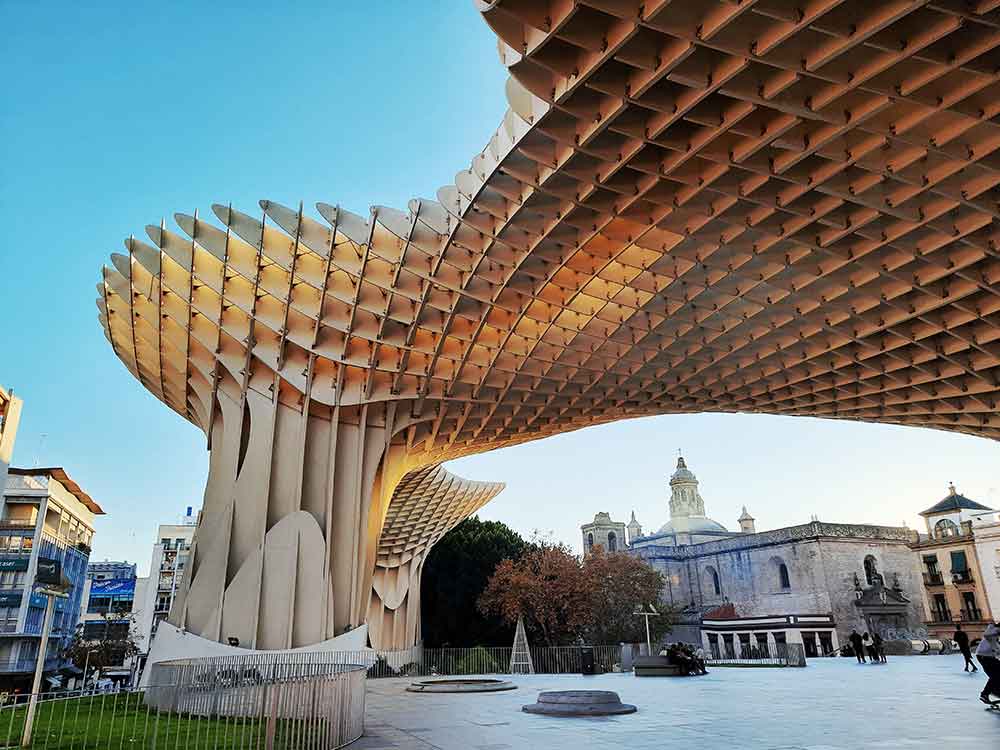
The Metropol Parasol is an impressive piece of modern architecture right in the heart of Seville.
It’s the world’s largest wooden structure, shaped like giant mushrooms – which is why it’s affectionately known as Las Setas (“the mushrooms” in Spanish)
The best time to visit is just before sunset so you’ll get to see the cityscape before they light up the structure with the aurora light show.
You can also take a virtual reality tour to see how Seville has evolved over the centuries.
Metropol Parasol Location: Pl. de la Encarnación, s/n, Casco Antiguo, 41003 Sevilla
Seville Rooftop Bars
After visiting La Setas, head to some of Seville’s popular rooftop terraces. There are plenty to choose from but here are my top suggestions.
- Hotel Doña María Sevilla
- La Terraza del EME
- Ático
- Torre Sevilla
📌Good to know: If you’re after more livelier things to do in Seville at night, then I recommend Alameda de Hercules, known simply as Alameda. It’s one of my favourite hangouts and you’ll find a mix of bars, restaurants and clubs as well as a mix of locals and tourists.
5 Days in Seville, Spain FAQs
How Many Days Do You Need in Seville?
If you’re wondering how many days in Seville are enough to see the highlights, I’d say a minimum of about three days. There’s no shortage of things to see in Seville.
When Is the Best Time to Visit Seville?
The best time to visit Seville is during spring and autumn. This is when Seville’s weather is perfect. If you do decide to visit Seville in April, just be aware this is the most expensive and busiest time of the year to visit the city as two major events happen: Semana Santa and Feria de Abril.
Is 5 Days in Seville Enough?
By following this Seville itinerary, in 5 days you’ll be able to see the highlights plus additional historic sites. You’ll also be able to tick some of the city’s museums, and off-the-beaten-track places and even squeeze in a day trip to a nearby town off your Seville to do list
Why Is Seville, Spain Famous?
Seville is famous for its stunning architecture like the Real Alcázar and Seville Cathedral. It’s also the birthplace of flamenco dancing. Plus hosts one of Europe’s largest Easter celebrations (Semana Santa) and the weeklong Feria de Abril festival.
Are Things Closed in Seville on Sunday?
Many shops and supermarkets are closed on Sundays. However, most tourist attractions and convenience stores will be open.
Ready to Spend 5 Days in Seville?
As you’ve read, 5 days in Seville, gives you enough time to get a decent experience of what the city has to offer.
From exploring iconic sights like the Alcázar to Plaza de Espana to more off-the-beaten-track places, there’s so much to see here – trust me, after all this time living here, I’m still discovering new places.
For more tips and ideas on how to make the most of your city break to Seville, check out our other articles and start planning your perfect itinerary today!
Have a question? then don’t forget to join our free Facebook Group: Seville Things To Do and ask the community.
Want to discover more about Seville? then check out these other great articles to find out more.
Done-For-You Itineraries
- One Day in Seville Itinerary
- Two Days in Seville Itinerary
- Three Days in Seville Itinerary
- Five Days in Seville Itinerary
Things To See & Do In Seville
- Best Places to Watch Flamenco in Seville
- 21 Great Things to Do in Seville
- 18 Must-See Galleries and Museums in Seville
- Best Time to Visit Alcazar of Seville
- Things to Do in Seville for Free
- Best Artisan and Flea Markets in Seville
- 23 Best Day Trips From Seville
- Where’s The Nearest Beach to Seville? [Within a 2-Hour Drive]
- 34 Instagram Spots in Seville [+ Photo Location Map]
Food & Drink in Seville
- Eat Your Way Around Seville’s Top Food Markets
- Discover the Best Tapas in Triana Neighbourhood
- The Best Flamenco and Tapas Tour in Seville
- Can You Drink Tap Water in Seville?
- Where to Find the Best Breakfast in Seville
- Where to Find the Best Coffee in Seville
Seville Travel Tips
- How To Survive Seville In Summer
- Things to Do in Seville in the Rain
- What to Wear to Seville Cathedral
- What Is Seville Famous For?
- How Many Days in Seville Do You Really Need?
- How to get from Seville Airport to the City Centre
- Where to Stay in Seville, Spain: Best Neighbourhoods
- Why Visit Seville? 15 Reasons to Visit Seville


