What To See in 3 Days in Seville, Spain [Map & Local Tips]
Planning to spend 3 days in Seville and not sure what to include on your itinerary?
Between us, we’ve explored every corner of the city so have sussed out all the best spots that are a must-see and the ones you can skip, ensuring you get the most out of your trip to Seville.
Whether you’re here for a short break or just passing through, this guide will help you experience the best of Seville in 3 days, from iconic landmarks to the best neighbourhoods as well as plenty of insider tips and some lesser visited places.
Ready to start planning? Read on for all the essentials!

Some of the links on The Seville Guide are affiliate links. If you click through and make a purchase, we may earn a small commission. You can read our disclosure policy here. We appreciate your support, thank you.
The Best Seville in 3 Days Itinerary
This packed itinerary focuses on all the best things to do and see in Seville.
Our practical guide is filled with tips on planning your visit, details on must-see spots, and advice on making the most of your time in this fabulous city.
Best Things to See in Seville in Three Days
- Real Alcázar
- Cathedral of Seville & La Giralda
- Barrio Santa Cruz
- Flamenco Show
- Palacio de las Dueñas or Casa de Pilatos
- Metropol Parasol (Las Setas)
- Plaza de España
- Parque de María Luisa
- Torre del Oro
- Triana Neighbourhood
- Italica Ruins
- Cartuja
Have a Question?
Ask in The Seville Guide Community!
Connect with fellow travellers and locals, share tips, and get the latest insights on what’s happening in Seville.
Seville 3 Days Itinerary: Day Breakdown
Day 1: Start your day early with the Real Alcázar before heading to Seville Cathedral and climbing the Giralda. Explore the narrow streets of Barrio Santa Cruz and Alfalfa Districts. Finish day one by experiencing an evening of tapas and flamenco.
Day 2: Choose between Palacio de las Dueñas or Palacio de las Pilatos on day two. Then check out the views from Metropol Parasol. Head to Plaza de España and relax in Parque de María Luisa. Wrap up the day with drinks at one of Seville’s gorgeous rooftop bars.
Day 3: Start your final day at the Torre del Oro and wander through the colourful Triana neighbourhood. Spend the afternoon by taking a trip to the Italica Ruins, or heading to the quirky area of Cartuja. End your trip with tapas at Bar El Rinconcillo and a fun evening in Alameda de Hercules.
Map of Places to Visit in Seville in 3 Days
Here’s a map of all the places we mentioned above which you’ll visit during your three days in Seville.
Click on the map for the interactive version.

Not Sure How Long to Spend in Seville?
So, we’re a little bit biased here because we live in Seville – we’re still far from being bored here, there’s so much to see and do.
But if you’re still planning your trip, check out our other done-for-you itineraries to get more ideas of things to see in Seville.
SEVILLE ITINERARY REVIEW
Not sure if your Seville itinerary actually works?
Send us your rough plan, and we’ll check it from a local point of view.
We’ll look at timings, ticket slots, walking distances, neighbourhood order, and anything that might make your trip feel rushed or harder than it needs to be.
- Find out what to keep
- See what to swap or skip
- Fix awkward timings before you book
- Get honest local feedback by email
3 Days in Seville Itinerary [Local’s Guide]
Seville 3 Day Itinerary: Day 1
Real Alcazar
Start your morning at The Real Alcázar. Because this is one of the top things to see in Seville, it gets busy.
Located in the heart of the historic centre, you’ll easily spot its grand walls and the striking red entrance with a lion above. It was originally a Muslim fort, it later became a royal palace after the Christian conquest.
The Royal Alcazar has been a UNESCO World Heritage site since 1987 and is still used today by the Spanish monarchs. Inside you’ll find room after room filled with gorgeous Mudejar-style architecture – a mix of Muslim and Christian design – as well as pretty gardens
The best time to visit the Royal Alcazar is early, and to enjoy it fully, we recommend spending at least 2 hours here – there’s a lot to see.
Some of our favourite places here are the Salon de Embajadores, Patio de las Doncellas, Salon de Los Tapices as well as the underground baths – these are especially nice if you’re looking to escape the intense Sevilliano heat.
🗺️ Location: Patio de Banderas, s/n, 41004 Sevilla, Spain
👉 Insider Tip: The palace is so popular, and wasting time trying to get hold of Alcazar tickets if they’ve sold out just eats into your holiday. As soon as you know your travel dates, book your ticket to get a decent time slot – they only let in a certain number of people per hour.
If you prefer to visit the Real Alcazar without the crowds, you might like this pre-entry ticket.
The Alone in the Alcazar Tour happens before the gates are open to the general public. This will give you the best experience – especially if you want photos without dozens of people in the way.


Seville Cathedral and Giralda
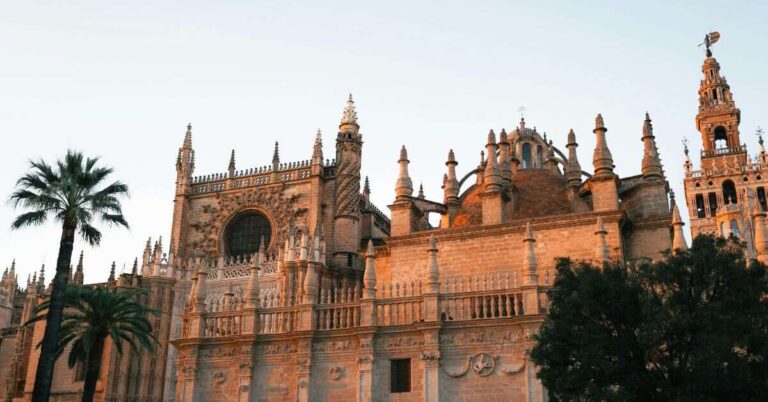
After the Alcazar, head to the impressive Cathedral of Seville and La Giralda.
The Seville Cathedral is the world’s largest Gothic cathedral and houses Christopher Columbus’ tomb. It’s also a UNESCO Heritage site.
Back when Seville was under Islamic rule, the area where the cathedral now sits was home to a mosque. After the Christian conquest, the mosque was converted into a church, and eventually replaced with the Gothic cathedral you see today.
The cathedral was completed in 1506, but parts like the Orange Courtyard and La Giralda still date back to the Moorish period.
The Giralda is the symbol of Seville. From the top of the 100-metre-tall tower is a viewing platform with stunning 360-degree views of the city below. Just a heads up – the bells are located at the top and can be very loud if they ring while you’re there!
Plan for about two hours to fully explore this massive landmark.
🗺️ Location: Av. de la Constitución, s/n, 41004 Sevilla, Spain
👉 Insider Tip: There are lots of different tickets for Seville Cathedral including a roof tour, audio guides, and stained glass window tours.
If you’re planning on seeing everything you can also opt for a combi ticket with early access to the Alcazar, Cathedral and Barrio Santa Cruz tour.

Barrio Santa Cruz and Alfalfa Districts
In the afternoon, explore two of the oldest areas in the city – Barrio Santa Cruz, and the Alfalfa neighbourhood. Both of these areas have plenty of tavernas where you can stop off to get lunch.
Barrio Santa Cruz once the Jewish Quarter, became home to the Jewish community after Ferdinand III’s Christian conquest. It’s known for its narrow cobblestone streets that open out into hidden courtyards filled with trees, fountains, and peaceful benches – it’s one of the most photogenic areas of Seville.
Even though it’s a small area, it’s easy to lose track of where you are – but that’s part of the fun! Getting lost here is the best way to explore it. If you want to dive more into the history of the area, then you can also join a small group tour of Barrio Santa Cruz.
Alfalfa District is a lively area with plenty of traditional tapas bars, it has a more local vibe to it compared to Barrio Santa Cruz, which although plenty of great places to eat also tends to cater for the tourist crowd.
👉 Insider Tip: In Spain, lunchtime is usually later than in many other European countries, typically around 2 or 3 pm. However, most tourist spots will offer food earlier if you’re hungry before then.

Flamenco Show
If you’re interested in culture, then one of the best things to do in Seville is to experience a flamenco show.
Flamenco is a huge part of the local identity – with the origins of the dance coming from the nearby Triana neighbourhood.
For the best flamenco experience we recommend going to one of the small intimate venues – La Casa del Flamenco is always a good choice!
The tiny courtyard venue only seats about 70 people, so you’re guaranteed to be close to the action – so close that you can feel the power of their stamps.
But flamenco isn’t just about the dance – the music and songs are just as important.
Related Article:
👉 Insider Tip: For a deeper understanding of this art form, consider joining a guided tour that explains the history and significance of flamenco.
It can really enhance your appreciation of what you’re watching and make the experience even more memorable.

Seville 3 Day Itinerary: Day 2
Palacio de las Dueñas or Casa de Pilatos
Start at either two of the stunning palatial buildings – you won’t be disappointed with either.
Palacio de las Dueñas
The palace is still owned by the Alba family and is filled with historic artefacts, family portraits, and antique furniture. It gives you a perfect glimpse into aristocratic life in historic Seville.
The building is beautiful and has plenty of Moorish influences that you will have seen in plenty of buildings around Seville – it also has an impressive garden, with plants and trees from all over the world and a gorgeous inner patio.
It’s worth visiting Palacio de las Dueñas not only for its beautiful architecture but also for the fascinating history behind one of Seville’s most important noble families.
🗺️ Location: C. Dueñas, 5, 41003 Sevilla, Spain

Casa de Pilatos
Casa de Pilatos mix of Italian Renaissance and Mudéjar styles. The palace is filled with gorgeous courtyards, marble statues, and stunning tiles.
It’s slightly smaller than Palacio de las Dueñas, but no less stunning. Also here you can visit the upstairs living quarters (which you can’t do at Dueñas),
Allow plenty of time to wander through the various rooms, gardens and courtyards with their impressive arches.
🗺️ Location: Plaza de Pilatos, 1, 41003 Sevilla, Spain
👉 Insider Tip: We love both of these palaces, so it’s a tough call about which we recommend visiting.
Another thing we love is that both of them also have a free entry time on Monday afternoon.


Metropol Parasol (Las Setas)
Metropol Parasol is found in La Encarnación Square. It also goes by the name “Las Setas,” which translates to The Mushrooms thanks to its shape.
This unique wooden structure was designed by German architect Jürgen Mayer who submitted the winding design for the redevelopment of the area.
It was completed in 2011 and holds the title of the largest wooden structure in the world.
La Setaas is split over 4 levels, the basement has the Antiquatrum – which houses Roman ruins which were found when it was being built, there’s also a food market, a shaded mezzanine with plenty of benches to relax on, and of course, the walk around the top.
The top level has a winding path that follows the curves of the structure. From here you get stunning panoramic views of Seville.
🗺️ Location: Pl. de la Encarnación, s/n, 41003 Sevilla, Spain
👉 Insider Tip: It’s worth being up here for the Aurora light show – your ticket allows you to go back on the same day. So we suggest going during the day so you can see the city and then going back later at night to see the lights.

Plaza de España
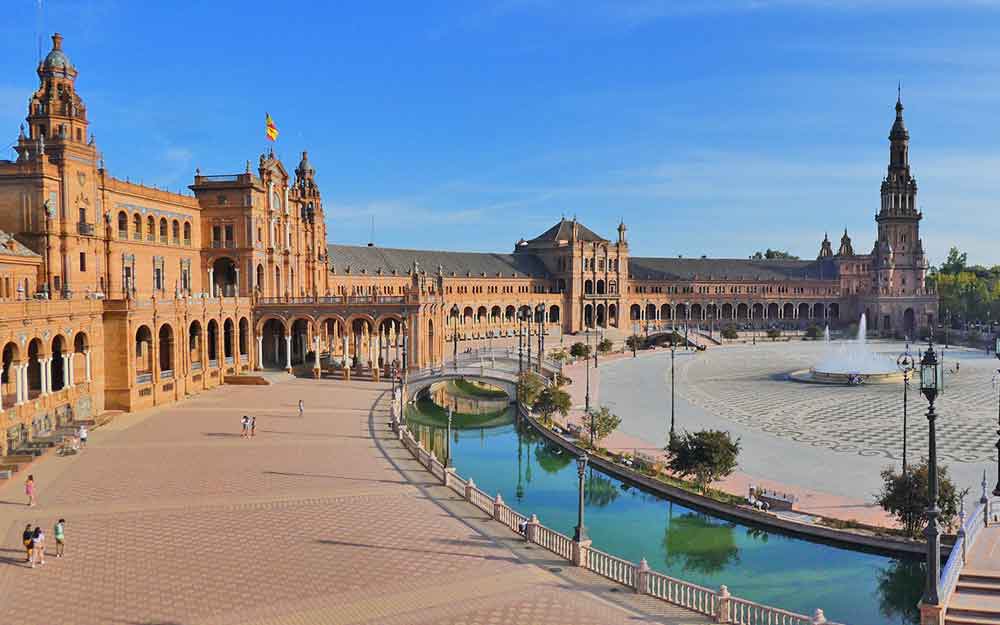
Plaza de España is one of Spain’s most famous squares.
It was built in 1929 for the Ibero-American Exposition and combines Moorish and Renaissance styles. The plaza’s curved shape and red-brick design are nothing short of stunning, with columns, balconies, and bridges all around.
You’ll see colourful tiled benches representing different Spanish provinces. The big fountain in the middle is perfect for cooling off if you catch the mist on a hot day. At night, it’s all lit up and changes colours.
👉 Insider Tip: If you’re looking to catch free Flamenco, check out the area under the central tower. You’ll often see dancers and musicians performing there from late morning through to the evening.
Grab a spot on the steps for a great view with Plaza de España in the background. While it’s free to enjoy, don’t forget to leave a tip!
Parque de María Luisa
After visiting Plaza de España, head over to neighbouring María Luisa Park, or Parque de María Luisa.
This massive green space covers around 100 acres and is the best park in the city.
It’s packed with things to explore. You’ll come across gazebos, fountains, and plenty of shady spots to relax.
The park even has a few museums tucked away within its grounds our favourite by far is the Museo de Artes y Costumbres Populares. Even if you don’t go inside, the exterior is worth a look – it’s one of the most stunning pavilions in Seville!
🗺️ Location: Plaza de España, s/n. 41013 Seville

Rooftop Bars
Finish off day 2 with some of Seville’s stunning rooftop bars. There are plenty of options around the Cathedral and Girlada – both are lit up at night.
Two places we recommend are:
- Terraza Hotel Doña María: Seville’s original rooftop bar, right next to the Cathedral and La Giralda. In summer, it’s open to the public only in the evenings, as the rooftop and pool are for guests. In winter, you can visit anytime.
🗺️ Location: Calle Don Remondo, 19, 41004. - La Terazza de EME: A trendy rooftop bar with stunning views of the Cathedral. It’s on top of the EME Hotel. Drinks are pricier, but the views make it worth it.
🗺️ Location: Calle Alemanes, 27, 41004.
Seville 3 Day Itinerary: Day 3
Torre del Oro
Start your third day at Torre del Oro, also known as the Gold Tower.
This historic landmark dates back to the 1200s and was originally one of two watchtowers that protected Seville’s entrance. It even served as a prison during the Middle Ages.
Nowadays, it’s a museum split across two levels: the first one explores the tower’s role in the city’s defence, while the second houses a maritime museum.
Make sure to climb to the top for amazing views of the cathedral, the old city, and the bridges crossing the Guadalquivir River.
You’ll also get a sneak peek of Triana, your next stop.
🗺️ Location: Torre del Oro, Paseo de Cristóbal Colón, s/n, 41001 Sevilla, Spain

Triana Neighbourhood
After visiting the tower, cross Puente de San Telmo and then take a right onto Calle Betis.
Calle Betis is one of the most photogenic streets in Seville with its colourful houses lined up against the banks of the Guadalquivir River.
At the end of this road, you’ll be in the central hub of Triana, a more residential neighbourhood with a laid-back vibe, different from the busier Seville Centre.
Triana is home to Seville’s tile-making industry and many of the decorative and colourful tiles you will have seen around the city come from here. It’s worth stopping by Centro Cerámica to learn more about this tradition and maybe pick up some hand-made souvenirs.
While you’re in Triana, two other spots are worth a visit.
The first is Mercado de Triana – one of Seville’s best food markets – here you can explore stalls with fresh produce and enjoy local tapas.
The second is Castillo de San Jorge, the ruins of an ancient castle discovered beneath the market. The museum goes into the area’s history, with a focus on the Spanish Inquisition.

Italica Ruins or Cartuja
Here are two options for what to do in the afternoon.
You could of course spend more time in the city, but these both take you away from the main tourist centre and let you explore a different side of Seville which most don’t venture to.
Roman Ruins of Italica
If you’re a fan of ancient ruins, then we suggest visiting Italica ruins. They are located just outside Seville.
The site dates back to Roman times and is home to a large amphitheatre, which once seated 25,000 people. It’s also famous for its well-preserved mosaics and was a filming location for Game of Thrones (you might recognise it as the Dragonpit!).
Getting there is easy – just hop on a bus from the Plaza de Armas station, it stops directly outside of the ruin site. Look for one which says Santiponce on it. The journey takes about 30 minutes, making it a convenient afternoon trip.
🗺️ Location: Av. Extremadura, 2, 41970 Santiponce, Sevilla
👉 Insider Tip: The Seville summer is insanely hot, and there’s no shade in Italica. So if you plan to visit then, go early in the morning when it is cooler. At all times of the year, we suggest wearing sunglasses, wearing a hat and taking plenty of water.

Cartuja
A little bit off the main tourist trail and just north of Triana you’ll find Cartuja.
Here is where you’ll find the remains of Expo 92 or the Universal Exposition, which was held from April to October 1992, celebrating the 500th anniversary of Columbus’s voyage to the Americas.
Over those six months, countries from around the world built impressive pavilions, showcasing culture, technology, and innovation.
It’s a paradise for anyone interested in urban exploration, photography, or simply satisfying curiosity about forgotten places.
Another place worth visiting in Cartuja is the Centro Andaluz de Arte Contemporáneo. This contemporary art museum is housed in an old monastery, adding a touch of modern culture to this otherwise abandoned area.

Tapas at Bar El Ricnoncillo
Start the evening at Bar El Ricnoncillo, which is Seville’s oldest tapas bar.
It has a buzzing, old-school vibe and plenty of old-world charm.
It’s a popular spot for both locals and tourists, thanks to its authentic atmosphere and delicious traditional tapas.
🗺️ Location: Calle Gerona, 40, Casco Antiguo, 41003 Sevilla
👉 Insider Tip: The place gets really busy, so it’s best to go either early in the evening or much later at night if you want to avoid the crowds.

Alameda de Hercules
To finish off your 3 days in Seville, head to Alameda de Hercules, known simply as Alameda.
From Bar El Rincocillo, wander up through the Feria neighbourhood – you might even want to stop here for a drink, before heading on towards Alameda de Hércules. Both spots are full of life in the evenings.
Feria has a mix of cosy bars with a more local vibe, while Alameda is lively with plenty of open-air spaces, trendy bars and a few clubs where people hang out late into the night.
3 Day Seville Itinerary: Know Before You Go
Getting To Seville
Travelling to Seville is straightforward, with Seville Airport (SVQ) being the main entry point.
It’s located just outside the city with several convenient transport options to reach the centre.
If you’re staying centrally, the Airport Bus is a good choice. It takes around 40 minutes, tickets are €5 for a one-way trip. You can buy a ticket on board, or in advance online.
For convenience, opt for a private airport transfer straight to your hotel door.
✔️Good to know: You can find out more about all the transport options in our detailed guide about getting from Seville Airport to Seville city centre.
Getting Around Seville
You won’t need a car for this 3 day Seville itinerary since everything is close together (except Italica, which you can use the local bus for).
The city is fairly small, so it’s easy to get around.
If you’re not up for walking, then use the city’s many cycle paths – it’s mostly flat here. But because of the cobblestones, we recommend exploring the old town on foot.
👉 Insider Info: If you’re visiting Seville as part of a longer road trip around the region, we don’t recommend driving inside the city walls. The mix of narrow, lots of pedestrianised areas, one-way streets and pretty much no parking just make it a frustrating experience.
Where to Stay in Seville
Seville has lots of great neighbourhoods to choose from.
For 3 nights in Seville, we suggest staying somewhere central, so all the main sights are within walking distance. Seville is a very safe city.
We’ve included a map below, which shows the best areas to stay in Seville there are plenty of options for every budget. However, if you want to splash out, then we recommend checking out Seville’s original luxury hotel, the Hotel Alfonso XIII.

Have Longer in Seville?
Seville is a great city to base yourself in for exploring more of the region. There are plenty of great day trips to take from the city.
Here are 5 top ideas for a day trip from Seville:
- Córdoba – Just an hour away by train, Córdoba is famous for the stunning Mezquita, a unique mosque-cathedral with striking architecture.
- Ronda – Known for its dramatic cliffs and stunning bridge, this charming town offers beautiful views and a taste of Andalusian history.
- Jerez de la Frontera – Visit Jerez for its sherry wine cellars and traditional Andalusian horse shows, just an hour from Seville.
- Carmona – A lesser-known gem, this ancient town is packed with Roman ruins, a medieval fortress, and charming streets, only 30 minutes away.
- Cádiz – One of Europe’s oldest cities, Cádiz has beautiful beaches, historic plazas, and charming cobblestone streets, just a 1.5-hour train ride from Seville – it’s very popular during the summer months as people escape the city heat, so book train tickets early.

Seville in 3 Days FAQs
When Is the Best Time of Year to Visit Seville?
The best time to visit Seville is in spring (March to May) or autumn (September to November). The weather is warm but not too hot, making it perfect for exploring. Summertime in Seville can be brutal, sometimes hitting the mid 40s°C, so it’s best to avoid visiting during the summer months if you’re not used to intense heat.
How Many Days Do You Need in Seville?
To really enjoy Seville, longer is better. There are plenty of things to do in Seville in 3 days. You’ll have enough time to see the main sights without rushing and still have time to wander around the local neighbourhoods.
What to See in Seville Spain in 3 Days?
In three days, you can easily tick off the top things to do in Seville. Start with the Real Alcázar, Seville Cathedral, and the Giralda bell tower. Then, visit Plaza de España and wander around the Triana neighbourhood. Be sure to catch a flamenco show and finish with stunning views from Metropol Parasol.
Hopefully, this article has given you plenty of ideas on what to do in Seville for 3 days. From exploring historic sites to enjoying local food and culture, Seville has so much to offer.
Although 3 days in Seville is enough time to scratch the surface and cover the city’s highlights, there’s plenty more to discover.
Have a question? then don’t forget to join our free Facebook Group: Seville Things To Do and ask the community.
Want to discover more about Seville? then check out these other great articles to find out more.
Done-For-You Itineraries
- One Day in Seville Itinerary
- Two Days in Seville Itinerary
- Three Days in Seville Itinerary
- Five Days in Seville Itinerary
Things To See & Do In Seville
- Best Places to Watch Flamenco in Seville
- 21 Great Things to Do in Seville
- 18 Must-See Galleries and Museums in Seville
- Best Time to Visit Alcazar of Seville
- Things to Do in Seville for Free
- Best Artisan and Flea Markets in Seville
- 23 Best Day Trips From Seville
- Where’s The Nearest Beach to Seville? [Within a 2-Hour Drive]
- 34 Instagram Spots in Seville [+ Photo Location Map]
Food & Drink in Seville
- Eat Your Way Around Seville’s Top Food Markets
- Discover the Best Tapas in Triana Neighbourhood
- The Best Flamenco and Tapas Tour in Seville
- Can You Drink Tap Water in Seville?
- Where to Find the Best Breakfast in Seville
- Where to Find the Best Coffee in Seville
Seville Travel Tips
- How To Survive Seville In Summer
- Things to Do in Seville in the Rain
- What to Wear to Seville Cathedral
- What Is Seville Famous For?
- How Many Days in Seville Do You Really Need?
- How to get from Seville Airport to the City Centre
- Where to Stay in Seville, Spain: Best Neighbourhoods
- Why Visit Seville? 15 Reasons to Visit Seville
Have a Question?
Ask in The Seville Guide Community!
Connect with fellow travellers and locals, share tips, and get the latest insights on what’s happening in Seville.