
Barrio Santa Cruz, Seville: Jewish Quarter Guide
Most visitors to Barrio Santa Cruz in Seville follow the same route: Cathedral, Alcázar, a quick wander through the prettiest lanes, a photo under the orange trees, and then back to the hotel.
I get why. Santa Cruz looks exactly how people imagine Seville will look: narrow shaded streets, whitewashed walls, tiled patios, orange trees, and glimpses of the Giralda appearing when you least expect it.
But the neighbourhood deserves more than a pretty wander.
I’ve called Seville home for over six years, and for two and a half of those, I lived in Barrio Santa Cruz. It was my neighbourhood: where I walked home at night, met friends for drinks, escaped the worst of the summer heat, and learned which corners still feel quiet even when the rest of the city is packed.
Santa Cruz is the oldest part of the city and was once the heart of the Jewish Quarter in Seville. That history is still there, but it is easy to miss if you don’t know what you are looking at.
This guide will help you see the neighbourhood properly, not just pass through it. I’ll cover the major landmarks, quiet plazas, historic streets, Jewish history, places to eat and drink, and how to plan your time, whether you have two hours, half a day, or longer.

Some of the links on The Seville Guide are affiliate links. If you click through and make a purchase, we may earn a small commission. This allows us to create more helpful and honest guides that you can use for free. You can read our Disclosure Policy here. We appreciate your support, thank you.
5 Top Things to See in Barrio Santa Cruz
If you are short on time, these are the places I would prioritise in Barrio Santa Cruz.
- Seville Cathedral and the Giralda: the world’s largest Gothic cathedral, with one of the best viewpoints in the city from the top of the tower. Book tickets in advance.
- Real Alcázar: Seville’s royal palace, still used by the Spanish royal family, with some of the most beautiful gardens in the city. Go early if you can.
- Archivo General de Indias: free entry, usually much quieter than the Cathedral or Alcázar, and home to documents connected to Spain’s empire in the Americas. Most people walk straight past it.
- Callejón del Agua: one of the most photogenic streets in Santa Cruz, running alongside the Alcázar walls. I like it best early in the morning or just before sunset, when it feels less like a thoroughfare.
- Plaza Santa Marta: small, peaceful, and genuinely one of the most beautiful corners of Seville. It is very easy to miss, which is part of why it still feels special.
The sections below cover all of these in detail, along with the plazas, side streets, legends, restaurants, flamenco venues, and practical tips that will help you experience the barrio properly.
Have a Question?
Ask in The Seville Guide Community!
Connect with fellow travellers and locals, share tips, and get the latest insights on what’s happening in Seville.
What is Barrio Santa Cruz?
Barrio de Santa Cruz is Seville’s oldest neighbourhood and the most visited part of the city’s historic centre, also known as the Casco Antiguo.
It sits between Seville Cathedral, the Alcázar walls, and the Jardines de Murillo, which is why most first-time visitors end up here almost immediately.
Technically, Santa Cruz and the neighbouring area of San Bartolomé together make up the historic Jewish Quarter in Seville. The two blend into each other, and most people refer to the whole area simply as Santa Cruz or the barrio.
This is the Seville people picture before they arrive: narrow shaded streets, orange trees, whitewashed walls, tiled signs, iron balconies, and little plazas that appear suddenly at the end of tight lanes.
It is beautiful, but it is not undiscovered.
Santa Cruz is the most tourist-heavy part of Seville, especially around the Cathedral, the Alcázar, Calle Mateos Gago, and Patio de Banderas.
When I lived in Santa Cruz, I learned quickly that timing matters. Early morning feels completely different from midday, and the smaller plazas can still feel calm even when the streets around the Giralda are packed.
Map of Barrio Santa Cruz, Seville
Use this interactive map of Barrio Santa Cruz to find the main plazas, historic streets, and landmarks around the old Jewish Quarter we cover in this article.

The History of Seville’s Jewish Quarter
The history of the Jewish Quarter in Seville is not a single story. It is Roman, Moorish, Jewish, Christian, and post-Inquisition history layered into the same small tangle of streets.
That is one of the things I find most interesting about Santa Cruz.
You can walk through it in twenty minutes and think it is just a pretty neighbourhood, but almost every plaza or side street has another layer underneath it.
Santa Cruz Timeline
Roman Origins
Santa Cruz sits on the edge of the ancient Roman city of Hispalis. Three columns from a 1st-century Roman temple still stand on Calle Mármoles, although they are easy to miss if you don’t know they are there.
Moorish Seville
Under Moorish rule, Seville was a major city in Al-Andalus. Jewish communities lived throughout the city rather than only in one clearly defined quarter, and Santa Cruz was not yet the distinct Jewish neighbourhood it later became.
Ferdinand III Takes Seville
When Ferdinand III of Castile conquered Seville from the Almohads in 1248, the city’s Jewish population was concentrated in this area. By the late medieval period, Seville had one of the most important Jewish communities, centred around what is now Santa Cruz and San Bartolomé.
The Wall Around the Jewish Quarter
A wall was built around the Jewish quarter during this period. What I find especially interesting is that historians still debate its purpose.
The Inquisition and 1492
Jews and Christians lived together here for two centuries, but that coexistence became increasingly unstable. The first tribunal of the Spanish Inquisition was held in Seville in 1478, which marked a major turning point for Jewish life in the city. Then, in 1492, the Alhambra Decree ordered all Jews in Spain to convert to Christianity or leave. The barrio emptied almost overnight and entered a long period of decline.
Later Centuries
The Santa Cruz you see today is not purely medieval. The 1755 Lisbon earthquake caused serious damage, and much of the neighbourhood was later rebuilt in the 18th century. It was remodelled again before the 1929 Ibero-American Exposition, when Seville reshaped parts of the city for visitors.
The Main Sights in Barrio Santa Cruz, Seville
Santa Cruz is dense with Seville’s tourist attractions and landmarks. But not everything needs the same amount of time or energy. These are the main sights in and around the barrio, and how I would prioritise them.
1. Seville Cathedral and the Giralda
Seville Cathedral is the world’s largest Gothic cathedral and one of the city’s essential sights. Christopher Columbus is buried inside, and the Giralda, the tower you can see from all over Santa Cruz, is one of the best viewpoints in Seville.
The Giralda was originally the minaret of the Almohad mosque that stood on this site before the cathedral was built. Instead of stairs, you climb a series of ramps, originally designed so the tower could be ascended on horseback.
If you are also visiting the Alcázar on the same day, I would do one early and leave breathing room before the other.

Book tickets for the Cathedral in advance
The queue without a booking can be painfully long, especially in spring, and around Semana Santa.

2. Real Alcázar
The Real Alcázar is Seville’s royal palace and one of the most beautiful places in the city. It is still used by the Spanish royal family when they visit Seville, and the complex blends Mudéjar, Gothic, Renaissance, and Baroque styles in a way that should feel chaotic but somehow works perfectly.
The gardens are the part I always think people underestimate. They are huge, layered, and much more enjoyable before the day heats up. Game of Thrones fans will also recognise parts of the palace gardens as the Water Gardens of Dorne.
The Alcazar sells out and gets insanely busy, so if you hate crowds, book the first entry slot if you can. By mid-morning, especially in peak season, the palace and gardens fill with tour groups.
There is a café inside, and although it is not cheap, sitting there for twenty minutes with a drink while peacocks wander around is hard to regret.
Hate Crowds?
There are only a limited number of VIP early-entry tickets to the Alcázar each day. Choose this tour if you want to get inside before the biggest crowds arrive and enjoy the palace without fighting your way through hundreds of other visitors.

3. Archivo General de Indias
The Archivo General de Indias is one of the easiest major sights in Seville to overlook, mostly because it sits between two giants: the Cathedral and the Alcázar.
That is exactly why I like it.
Seville has quite a few places you can visit for free, and this is one of them.
Inside is usually calm, as most people walk straight past without realising what is inside. The archive holds millions of documents relating to the Spanish Empire, including maps, letters, and records connected to Spain’s presence in the Americas.
I wouldn’t prioritise this if you only have two hours in Santa Cruz or are travelling with young children, but if you like history, maps, empire-era documents, or quiet museums, it is one of the best low-effort stops in the area.
Allow at least thirty minutes.

4. Hospital de los Venerables
Hospital de los Venerables is a 17th-century Baroque building in the heart of Santa Cruz, originally built as a home for retired priests. Even if you don’t go inside, the building is worth knowing about because it sits on one of the loveliest squares in the barrio, Plaza de los Venerables.
Inside, the hospital is known for its Baroque church, ceiling murals by Juan de Valdés Leal, frescoes by Lucas Valdés, and the Velázquez Centre, which includes works connected to Velázquez, Murillo, and Valdés Leal.

Good To Know
At the time of writing, Hospital de los Venerables is closed for maintenance. The building and Plaza de los Venerables are still worth passing by, and stopping for a drink at one of the small bodegas in the square.

5. Iglesia de Santa María la Blanca
Iglesia de Santa María la Blanca is one of the clearest physical links to the Jewish Quarter in Seville.
It was originally a synagogue before being converted into a church in the 14th century, and its layered history makes it worth the short detour. I’d go, just to see the stunning ceiling inside!
Technically, it sits just outside the strict Barrio Santa Cruz boundary on Calle Santa María la Blanca, but I would still include it in any Santa Cruz walk. It is only a few minutes from the main tourist streets, and the interior is far more striking than the plain exterior suggests.
I would prioritise it if you are interested in Jewish history, Mudéjar architecture, or quieter historic stops beyond the Cathedral and Alcázar.

6. Museo del Baile Flamenco
Museo del Baile Flamenco was founded by Cristina Hoyos, one of Seville’s most respected flamenco dancers. The museum covers the history, costumes, rhythm, and culture of flamenco, with live shows held in the courtyard or basement vault.
It is one of the easier flamenco experiences to book in central Seville, and I think it works well for first-time visitors who want something polished, accessible, and close to Barrio Santa Cruz.
It is still a visitor-focused experience, but that is not automatically a bad thing. If you want a deeper understanding of flamenco before booking a show, this is a useful place to start.

7. Casa de Murillo
Casa de Murillo is a small museum on Calle Santa Teresa, in the house where Bartolomé Esteban Murillo once lived.
Murillo was born in what is now Plaza de Santa Cruz, and his remains were buried in the church that stood there until it was demolished during the Napoleonic occupation.
This is not one of the major sights in Barrio Santa Cruz, but that is part of the appeal. It is usually quiet and works well if you want a short cultural stop away from the busiest streets.
I wouldn’t build your whole route around it, but if you are already nearby and interested in Murillo or Seville’s artistic history, it is an easy addition.
8. Aire Ancient Baths
Aire Ancient Baths is an Arab-style spa in a restored mansion near the Cathedral, with thermal pools, relaxation areas, and massage options.
It is not a historic sight in the same way as the Cathedral or Alcázar, but it can be a very good addition to any itinerary, especially in summer. By early afternoon in July or August, sightseeing in the heat can feel like hard work rather than fun.
I would book this for the hottest part of the day if you want a slower, more comfortable afternoon in the historic centre.
9. The Plazas of Barrio Santa Cruz
There are eleven plazas threaded through the barrio’s narrow streets. And you will naturally pass several as you wander.
You do not need to hunt down every single one, but a few are worth seeking out deliberately.
- Patio de Banderas sits beside the Alcázar walls and gives you one of the best framed views of the Giralda through the old archway. It is also one of the easiest places to orient yourself before walking into the narrow streets of Seville’s historic centre.
- Plaza de Santa Cruz is the symbolic heart of the neighbourhood. The wrought-iron Cruz de la Cerrajería stands in the centre, and the church that gave the barrio its name once stood here before it was demolished during the Napoleonic occupation.
- Plaza Doña Elvira is one of the prettiest plazas in Santa Cruz, with orange trees, tiled benches, and a small fountain. It is touristy, but still lovely, especially early in the day.
- Plaza Santa Marta is my favourite if you want somewhere quieter. It is tiny, easy to miss, and still feels peaceful even when the main streets are busy.
- Plaza de las Cruces is small but memorable, with three columns topped by crosses on stone plinths. It is not somewhere you need to linger for ages, but it is a pretty stop if you are wandering through the old Jewish Quarter.
- Plaza de los Venerables is the liveliest option, with terrace bars around the edges and the Hospital de los Venerables on one side. It is not the calmest plaza, but it is a good place to stop for a drink.
You probably also walk across Plaza del Triunfo, Plaza de la Alianza, Plaza de los Refinadores, Plaza de Alfaro, and Plaza de la Escuela de Cristo while exploring the barrio. They are worth noticing, but I wouldn’t stress too much if you miss them (unless you particularly enjoy slow, detailed wandering).
Local Tip
For sitting and lingering, I would choose Plaza Santa Marta, Plaza Doña Elvira, or Plaza de la Alianza. For atmosphere and people-watching, go to Plaza de los Venerables.
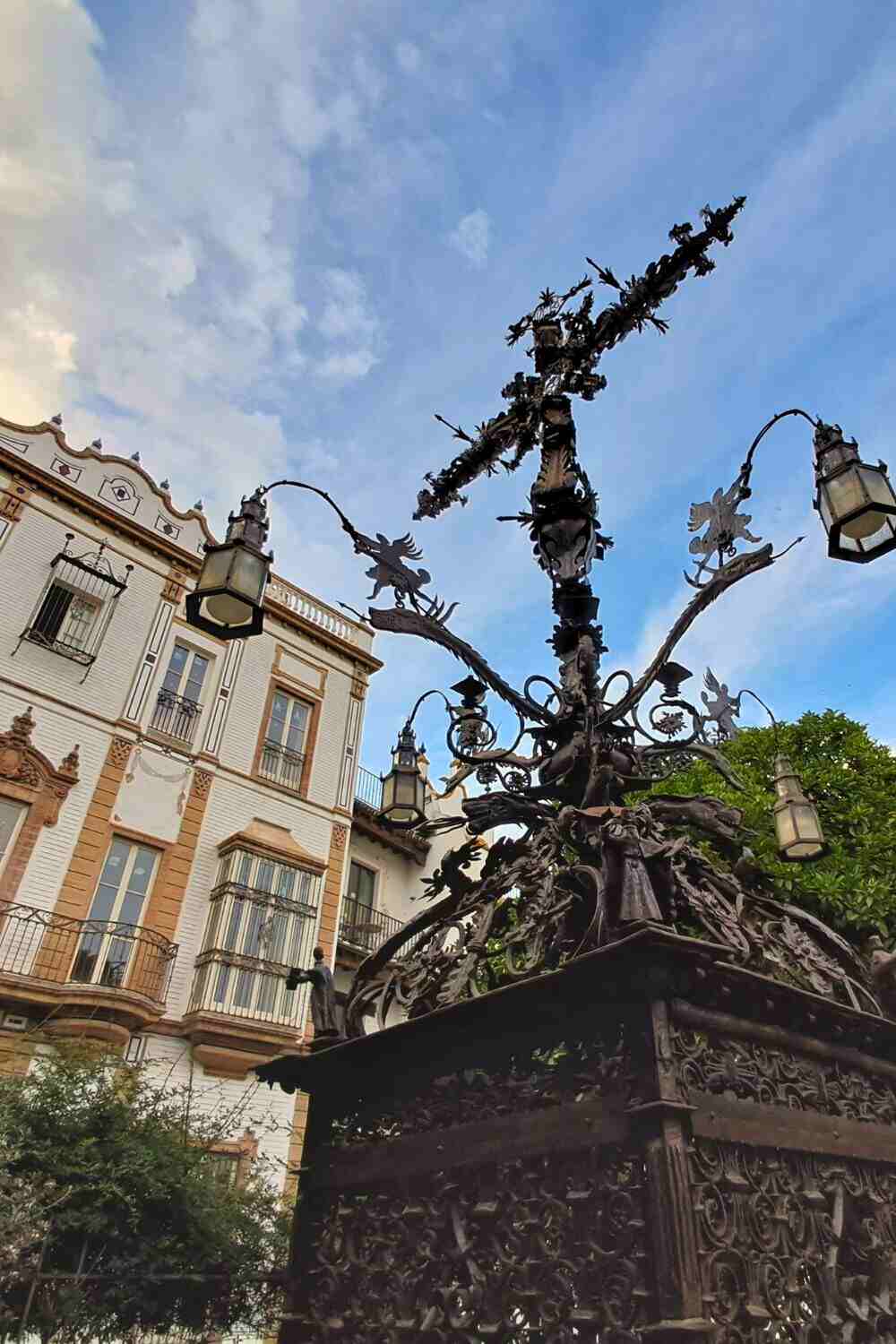
10. Streets Worth Exploring in Barrio Santa Cruz
Google Maps is not always your friend in Barrio Santa Cruz.
The streets are too narrow, the buildings are too high, and half the time your little blue dot seems to give up before you do. Even when you know the area, it is easy to feel like you are walking in circles.
The good news is that Santa Cruz is not actually that big. If you get lost, you will eventually come out near the Cathedral, the Alcázar, Jardines de Murillo, or a street you recognise.
Leave a little time to wander rather than trying to follow every turn perfectly.
- Calle Mateos Gago is the main route from the Giralda into the barrio, lined with tapas bars and views back towards the tower. It is useful to know, but it is also one of the busiest and most tourist-priced streets in the area. I would use it as a starting point, then step away into the smaller streets if you want Santa Cruz to feel calmer and more local.
- Callejón del Agua is the classic Santa Cruz street, running alongside the Alcázar walls and lined with plants and whitewashed buildings. It is much better early in the morning or later in the evening when it is not full of walking tours.
- Callejón de la Judería leads from Patio de Banderas into the old Jewish Quarter area through a narrow passage of arches and tight turns. It is short, but it gives you that immediate old-Seville feeling.
- Calle Susona is worth finding because of the legend attached to it, which I cover below. Look for the small ceramic skull on the wall; most people miss it unless they know it is there.
- Calle Reinoso is one of the narrowest streets in Seville, known locally as the kissing street because the buildings almost touch overhead.
- Calle Mármoles is the one I would add if you like overlooked history. Three Roman columns still stand here, and most people walk past without realising what they are seeing.
You will also pass quieter streets such as Calle Vida, Calle Pimienta, Calle Jamerdana, and Calle Lope de Rueda as you explore. They are not must-sees individually, but they are part of what makes wandering through Santa Cruz enjoyable.

11. The Legends of Barrio Santa Cruz
Barrio Santa Cruz is full of stories, and these are two of the most famous legends linked to the neighbourhood. I am keeping them brief here because they fit better as part of a darker Seville route.
👉 For more of these stories, follow our self-guided Seville ghost tour
Don Juan Tenorio
The literary seducer Don Juan is closely tied to Santa Cruz. José Zorrilla’s play Don Juan Tenorio mentions the Hostelería del Laurel in Plaza de los Venerables, and local tradition links Don Juan himself with the same square.
You will also see his statue in Plaza de los Refinadores, while Plaza Doña Elvira is associated with Doña Inés de Ulloa, his great love. Even if you don’t know the play, these references add another layer to the plazas as you walk through the barrio.
The Legend of Susona
The legend of Susona is one of the most haunting stories in the old Jewish Quarter area.
Susona was the daughter of a wealthy Jewish merchant who, according to the story, betrayed her father’s plot to her Christian lover. Her father and the other conspirators were executed, her lover abandoned her, and Susona lived the rest of her life in disgrace.
Look for the small ceramic skull on Calle Susona, marking the house where she is said to have lived. I cover this story in more detail in our Seville ghost walk article, where we go into this along with the city’s darker tales.

Where to Eat and Drink in Barrio Santa Cruz
An honest starting point: Barrio Santa Cruz is the most tourist-heavy part of the city, and the restaurants reflect that.
Quality and value vary a lot, especially around Calle Mateos Gago and the streets closest to the Giralda.
That does not mean you should avoid eating here completely. Just be selective.
- Cervecería Giralda is one of the better-known stops on Calle Mateos Gago, set inside a former hammam. It is still central and busy, but it has more character than many of the tourist restaurants nearby.
- Taberna Álvaro Peregil is worth a quick stop for vino de naranja, Seville’s orange wine. It is not somewhere I would plan a full meal, but it is a classic Santa Cruz stop.
- For a drink with a view, Terraza Fulton is one of the most underrated rooftop bars in Seville, with a view of the Giralda. Despite it being in Barrio Santa Cruz, it’s quite often quiet here.
- Plaza de los Venerables is also good for a drink, especially if you want to sit somewhere lively and people-watch. For better-value tapas, I would usually step a few streets away from the main Cathedral-to-Alcázar route rather than choosing the first terrace you see.

Flamenco in Barrio Santa Cruz
The Museo del Baile Flamenco, which we mentioned earlier, is one of the best places to watch flamenco in Seville.
Another one is Los Gallos tablao, in Plaza de Santa Cruz. This is one of the longest-running flamenco venues in Seville. La Casa del Flamenco is another great option. The quality at both is high, and solid choices if it’s your first flamenco show.
Good To Know
In Seville, you might see the terms tablao and peña used to describe flamenco venues. Generally, a tablao is a staged, ticketed flamenco show, usually set up for tourists. A peña is a flamenco club run by and for aficionados, usually more local and less polished.
If you want a simple, central flamenco night, Santa Cruz works well. If you want something more local, I would look beyond the barrio.

Visiting Barrio Santa Cruz: What You Need to Know
Barrio Santa Cruz sits in Seville’s historic centre, the Casco Antiguo, between the Cathedral, the Alcázar walls, and the Jardines de Murillo. It is easy to reach on foot from most central areas, including El Centro, Arenal, San Bartolomé, and Puerta Jerez.
Cars cannot access most of the interior streets.
If you are staying inside the barrio, taxis usually drop you at the edge, and you will need to walk the final few minutes with your luggage. This is worth knowing before choosing where to stay in this part of Seville, especially in summer or if you are arriving with heavy bags.
Best time to visit: early morning before the main tour groups arrive, or later in the evening when the day-trippers have gone, and the streets feel more atmospheric.
How long to allow: around two hours for a wander, half a day if you want to visit plazas, churches, and smaller sights, or a full day if you are also doing the Cathedral and Alcázar.
Accessibility: the main routes, including Calle Mateos Gago and parts of Callejón del Agua, are manageable, but many smaller streets have uneven cobbles, narrow pavements, and tight corners. Wheelchairs, mobility aids, and pushchairs can manage parts of Santa Cruz, but it is not the easiest neighbourhood to navigate.
Safety: Santa Cruz is safe during the day and evening, but it is still a busy tourist area. Keep normal city-centre awareness, especially in crowds around the Cathedral, Alcázar, and Calle Mateos Gago.
Guided Tours of the Jewish Quarter in Seville
You can absolutely explore Barrio Santa Cruz on your own, but a guided tour is useful if you want to understand the Jewish history, legends, and hidden details behind the streets.
This is especially true, where a lot of the history is not obvious just by looking.
The stories around Susona, Don Juan, the old synagogue, and the former walls of the judería make much more sense when someone can point out the exact places as you walk.
Most walking tours last around two hours, which is enough time to cover the main plazas, narrow streets, and historic context without taking over your whole day.
Small-Group Jewish Quarter Discovery Walking Tour
Learn about the stories that took place in the area and immerse yourself in its medieval history with a local guide.

Where to Stay in Barrio Santa Cruz
Staying in Barrio Santa Cruz puts you right in the historic centre, within easy walking distance of the Cathedral, Alcázar, tapas bars, and flamenco venues.
The trade-off is logistics.
Many streets are too narrow for taxis, so you may need to walk a few minutes with your luggage. It can also be lively at night, especially in summer.
Two standout options include:
Hotel Casa 1800: a boutique hotel close to the Cathedral, known for its historic building, rooftop pool, and views over the Giralda. It is a strong choice if you want a central stay that still feels special.
Hotel Las Casas de la Judería: one of the most iconic hotels in Santa Cruz, made up of several historic houses connected by patios, corridors, tunnels, and courtyards. It feels very “old Seville” and is a good choice if you want atmosphere.
For more options, check out our full guide to the best hotels in Barrio Santa Cruz, including historic stays, boutique hotels, and places that work better if you are arriving with luggage.
Good to Know
Most hotels in Barrio Santa Cruz do not have a pool, but there are a few exceptions, including the two suggestions above. If you are visiting Seville in summer, having somewhere to cool off in the afternoon can make a huge difference.
For more options, read our full guide to the best hotels with rooftop pools in Seville.

Barrio Santa Cruz, Seville FAQs
Is Barrio Santa Cruz the same as the Jewish quarter in Seville?
Largely yes. Technically, the historic Jewish quarter also includes the neighbouring district of San Bartolomé. The two areas sit side by side, and most people refer to the whole zone as Santa Cruz or the barrio.
How long does it take to walk around Barrio Santa Cruz?
You can cover the main streets in an hour to ninety minutes. Allow half a day if you want to explore the plazas properly, stop for a drink, and take time in the quieter back streets.
Is Barrio Santa Cruz safe at night?
Yes. The main streets are well-lit and busy most evenings. Some of the smaller lanes are quieter after midnight, but normal urban awareness is all that is needed.
What is the best time of day to visit Barrio Santa Cruz?
Early morning, before about 9 am, or late evening after dinner. Midday in summer is the hardest time: heat and crowds overlap.
Is it free to walk around Barrio Santa Cruz?
Yes. The streets, plazas, and alleys are free to explore. Individual attractions, including the Cathedral, the Alcázar, and the Hospital de los Venerables, have their own entry fees.
What is the Callejón del Agua?
A narrow lane running alongside the Alcázar walls, named after the water channel that once supplied the palace. Lined with bougainvillaea and one of the most photogenic streets in the neighbourhood.
Can I drive into Barrio Santa Cruz?
Not really. Most of the streets inside the barrio are too narrow for vehicles. Taxis and cars drop passengers at the perimeter, typically near the Cathedral on Avenida de la Constitución or at the Alcázar entrance.
Have a Question?
Ask in The Seville Guide Community!
Connect with fellow travellers and locals, share tips, and get the latest insights on what’s happening in Seville.
Keep Exploring Seville’s Historic Centre
Barrio Santa Cruz is one of the best places to start in Seville’s historic centre, but it connects naturally to some of the city’s biggest sights and most atmospheric stories.
Once you have wandered the old Jewish Quarter, use these guides to plan what to see next nearby.
- Discover the Best Time to Visit the Real Alcázar of Seville
- Plan the Perfect One Day in Seville
- Follow a Self-Guided Ghost Tour Around Seville
Have a question? then don’t forget to join our free Facebook Group: Seville Things To Do and ask the community.
Want to discover more about Seville? then check out these other great articles to find out more.
Done-For-You Itineraries
- One Day in Seville Itinerary
- Two Days in Seville Itinerary
- Three Days in Seville Itinerary
- Five Days in Seville Itinerary
Things To See & Do In Seville
- Best Places to Watch Flamenco in Seville
- 21 Great Things to Do in Seville
- 18 Must-See Galleries and Museums in Seville
- Best Time to Visit Alcazar of Seville
- Things to Do in Seville for Free
- Best Artisan and Flea Markets in Seville
- 23 Best Day Trips From Seville
- Where’s The Nearest Beach to Seville? [Within a 2-Hour Drive]
- 34 Instagram Spots in Seville [+ Photo Location Map]
Food & Drink in Seville
- Eat Your Way Around Seville’s Top Food Markets
- Discover the Best Tapas in Triana Neighbourhood
- The Best Flamenco and Tapas Tour in Seville
- Can You Drink Tap Water in Seville?
- Where to Find the Best Breakfast in Seville
- Where to Find the Best Coffee in Seville
Seville Travel Tips
- How To Survive Seville In Summer
- Things to Do in Seville in the Rain
- What to Wear to Seville Cathedral
- What Is Seville Famous For?
- How Many Days in Seville Do You Really Need?
- How to get from Seville Airport to the City Centre
- Where to Stay in Seville, Spain: Best Neighbourhoods
- Why Visit Seville? 15 Reasons to Visit Seville


