Seville April Fair Guide for First-Timers: Feria de Abril 2026
If you’re visiting Seville in late April, you’ve timed it perfectly. The Seville April Fair, Feria de Abril in Spanish, is one of the most spectacular events in Europe, but most first-time visitors arrive with very little idea of how it actually works.
That’s where things go wrong.
People show up in trainers, wander the fairground wondering why they can’t get into any of the tents, and leave after two hours feeling vaguely confused.
I’ve been going to the Feria for years, and one of the things that surprises first-timers most is how long it takes before the fair really comes alive. Once you understand how it works, it becomes something you’ll want to come back for every spring.
This guide covers everything: the 2026 dates, how to get there, what to wear, how the caseta system actually works, what to eat and drink, and how to plan your day so you actually enjoy it.
If you’re feeling slightly intimidated by Feria, that’s completely normal.

Feria de Abril Guide: Key Takeaways
If you’re short on time, here’s the quick version:
- Most casetas are private, so don’t expect to wander into every tent
- The best time to go is usually from early evening onwards
- Dress smarter than you think you need to
- Public casetas are your best option if it’s your first Feria
- Pace yourself with rebujito
Have a Question?
Ask in The Seville Guide Community!
Connect with fellow travellers and locals, share tips, and get the latest insights on what’s happening in Seville.
What Is the Feria de Abril?
The Feria de Abril started in 1847 as a livestock fair. A practical, commercial event for trading cattle.
Within a few decades, the social side had completely taken over.
Today it’s a week-long celebration of Andalusian culture: sevillanas dancing, horse parades, traditional dress, sherry-based cocktails, and very long nights.
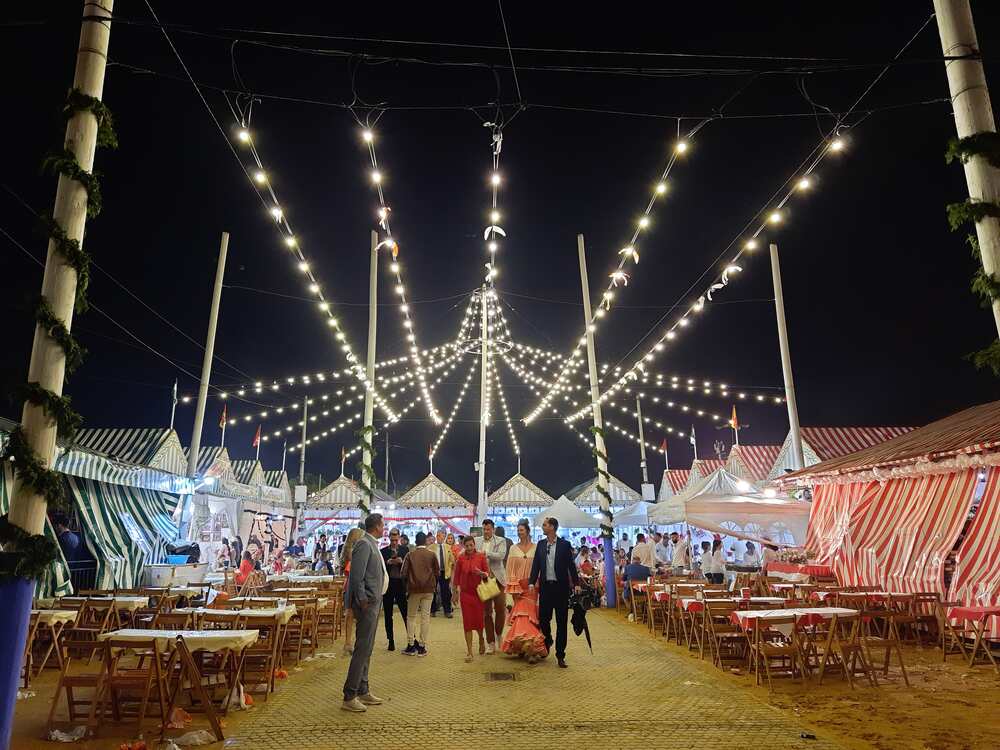
The first time you see it at night, it feels less like a festival and more like a temporary city built entirely for dressing up, dancing, and staying out far later than you meant to.
It is not a tourist event that happens to have locals in it. It’s a deeply local celebration that tourists are lucky enough to experience. That distinction matters because it shapes everything about how the fair works and what you can and can’t expect as a visitor.
Feria de Abril Seville 2026 Dates, Location and Getting There
When Is the Feria de Abril 2026?
The Seville Fair 2026 runs from Tuesday, 21 April to Sunday, 26 April. The fair traditionally begins two weeks after Semana Santa (Holy Week), which is why the date shifts each year.
The real opening moment is the alumbrado, the switching on of over 220,000 lights across the fairground, which happens at midnight on the night of Monday 20 April.
Locals gather in huge numbers to watch this. If you can make it, it’s worth the late night.
Even if you skip the rest of the opening night, seeing the lights come on once gives you a good sense of how emotionally important Feria is to the city.
Wednesday is a public holiday in Seville, so expect bigger crowds mid-week. Friday and Saturday tend to be the busiest days overall.
Fireworks close the event on the night of the 26th.

Good To Know
Planning a trip to Seville in April? Check out our detailed weather guide.

Where Is the Fair Held?
The fair takes place at the Real de la Feria, a purpose-built fairground in the Los Remedios neighbourhood, on the west bank of the Guadalquivir river.
The site covers 450,000 square metres (think of it as a temporary city), laid out in a grid of named streets lined with striped tents.
The main entrance gate, the Portada, is redesigned every year and is one of the visual highlights.
It’s also the point where a lot of first-time visitors stop, realise just how big the fairground is, and immediately understand why this is not something you “just pop into” for an hour.
In 2026, it was designed by Italian architect Davide Gambini, drawing on Seville’s architectural heritage.
How to Get There
The fairground is around 15 minutes from the city centre, and getting there is straightforward.
- By metro: Line 1 stops at Blas Infante, which is a short walk from the fairground entrance. This is the easiest option during busy periods.
- By bus: Several routes serve the fairground during Feria week, including the C1 and C2 circular routes. The city puts on extra services. Check the Tussam website for updated Feria routes closer to the date.
- By taxi or rideshare: Fine for getting there, but expect queues and traffic when leaving late at night. Factor in waiting time.
- On foot: If you’re staying in Triana or Los Remedios, it’s an easy walk. From the centre, it’s around 35 to 40 minutes on foot, which is manageable in the evening, less appealing in 30-degree heat.
Avoid driving. Parking near the fairground is heavily restricted, and it’s not worth the stress.
If you’re going in the evening, I’d personally choose the metro or walking over a taxi every time, unless you’re dressed up and staying out very late.

Understanding the Caseta System (The Most Important Thing to Know)
This is the section most travel guides skip. Read it carefully, because it will completely change your experience of Seville’s Feria de Abril.
Private Casetas: Why You Can’t Just Walk In
The fairground is made up of more than 1,000 casetas.
These are large striped tents, each with its own bar, kitchen, and sound system. They’re owned by families, friend groups, businesses, political parties, trade unions, and social clubs.
Most of them are private.
You cannot walk into a private caseta without an invitation from a member. There are no tickets to buy, no queue to join. If you try to walk in and someone stops you, that’s why.
This is the moment many tourists think they’re doing something wrong, when really they’ve just missed the most important bit of Feria etiquette.
This isn’t unfriendly, it’s just how the fair works. Once you understand that, the whole fair makes a lot more sense.
The caseta is essentially someone’s private party, extended to their family and friends. Sevillanos spend months planning their week, and their caseta is their base for the whole event.
Public Casetas: Where Anyone Can Go
The good news: there are public casetas where anyone can walk in freely, and they’re genuinely lively.
The Caseta Municipal de Turismo de Sevilla (also called Caseta Sevilla) is the main public option for visitors. It’s located at Calle Pascual Márquez 225-229, near the Calle del Infierno funfair end of the site.
You’ll find food, drink, dancing, and live music, so you can get the full Feria experience without needing an invitation.
For most, this is the least stressful way to experience the fair properly on a first visit. If you’re only going once and want a straightforward plan, start here.
Political parties and trade unions also open their casetas to the public. Look for PP, PSOE, CCOO and UGT signs at the entrance. These are often less crowded than the tourist caseta and give you a more local feel.
Beyond the casetas, the streets of the fairground are open to everyone. Honestly, some of the best people-watching happens between the tents anyway.
How to Get Invited to a Private Caseta
If you know any Sevillanos, maybe through work, study abroad programmes, language exchanges, or even online communities, this is the time to reach out.
An invitation to a private caseta is genuinely one of the best experiences Seville offers.
Short of that, some local tour operators run guided Feria experiences that include access to a caseta. This can be worth it for first-timers who want to understand what they’re seeing.
If you do get invited, treat it as a social invitation rather than a tourist attraction: dress well, be polite, and don’t treat the caseta like a photo stop.
Find out More
Want the full picture? Read our complete guide to Feria de Abril casetas for the best public options, realistic ways to get invited, and what to do if you do not get into one at all.

What to Wear to the Feria de Abril
Dress code is one of the most-searched questions about the fair, and for good reason.
Showing up in the wrong clothes won’t get you turned away at the gate, but it will make you stand out, and it will affect your experience.
Feria is one of those events where dressing for the occasion changes how confident and comfortable you feel once you’re there.
Women’s Dress Code: Traje de Flamenca
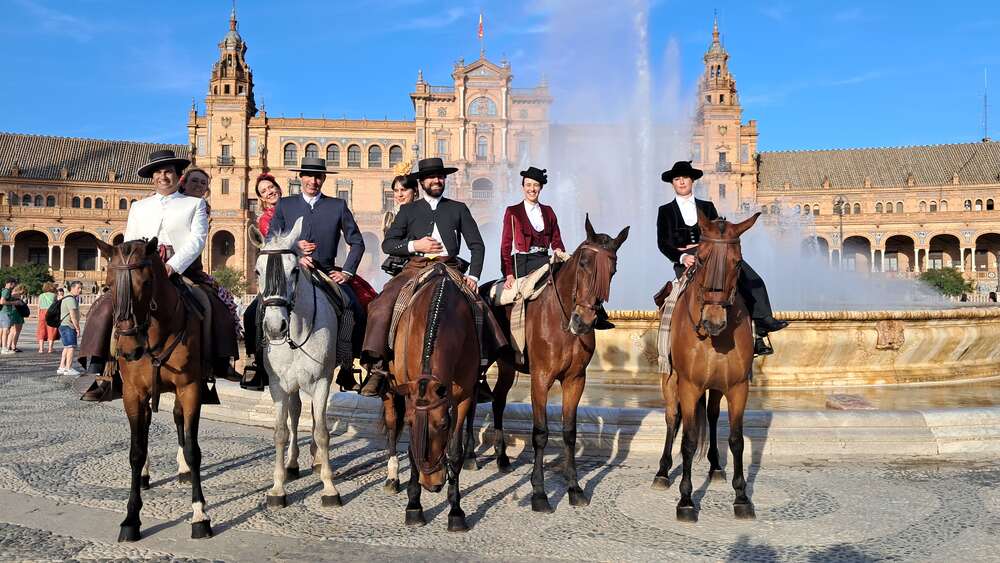
The traditional dress for women is the traje de flamenca (sometimes called a traje de gitana). These are beautiful, fitted, ruffled dresses in bright colours or polka dots, worn with a shawl (mantón), large earrings, flowers in the hair, and low-heeled court shoes or flats.
You do not have to wear one.
Plenty of women, including visitors and locals who aren’t wearing flamenca, go in smart dresses, skirts, or polished eveningwear and look perfectly appropriate.
But if you want to feel part of the atmosphere rather than just an observer, hiring or buying a dress makes a real difference.
It also makes a bigger difference at night, when almost everyone around you is dressed for the fair, and the whole event feels more formal.

Where to Hire or Buy a Flamenco Dress in Seville
Hiring is the practical choice for most visitors.
Several shops in the Triana neighbourhood and around Calle Sierpes have rental dresses starting at around €100 for the complete outfit.
Book in advance as stock runs low in the weeks before the fair.
Leaving it until the last minute usually means paying more, settling for a dress you don’t really like, or finding that the best sizes are already gone.
Buying makes sense if you’re planning to return or if you fall in love with a particular dress.
Prices start at around €80 for a basic dress and go up significantly for handmade or designer options. The Triana market area has several dedicated flamenca shops.
A quick Note
Accessories matter! A dress paired with completely wrong shoes or jewellery looks unfinished. Ask the shop staff for advice; they know exactly what works.
Men’s Dress Code: Traje Corto
The traditional male dress is the traje corto: short-jacketed suit in grey or beige, wide-brimmed hat, riding boots, and a shirt with a cravat or tie.
It’s the equestrian tradition of Andalusia, and it looks extraordinary on the right person.
Most male tourists wear a suit or smart trousers and a shirt. That’s completely acceptable.
A linen shirt with tailored trousers works well if you want to look appropriate without going fully traditional.
Jeans and a polo shirt technically work, but you’ll be noticeably casual compared with how most men dress at the fair, especially in private casetas.
What NOT to Wear (And Why Trainers Are a Problem)
The fairground is on a mix of cobblestones, tarmac and albero (fine yellow sand).
The mix of surfaces, plus heels, plus a long evening, plus a fair amount of rebujito is a well-known Feria hazard. Many women opt for low block heels, flats, or even elegant sandals for exactly this reason.
Trainers, shorts, flip-flops, and sportswear are not appropriate and will mark you out immediately as someone who didn’t do their research.
If you’re coming straight from a day of sightseeing, I highly recommend taking a change of clothes.
Even just swapping trainers and a day bag for smarter shoes and a small evening bag makes a big difference.
Food, Drink and How the Rebujito Works
Rebujito: Seville’s Fair Cocktail Explained
The rebujito is the drink of the Feria.
It’s simple: manzanilla sherry (a dry, slightly salty sherry from Sanlúcar de Barrameda) mixed with lemon-lime soda, poured over ice, and served in large pitchers.
It’s light, refreshing, and very easy to drink. It is also deceptively strong! That’s exactly why so many first-timers underestimate it.
The sherry base is around 15% ABV, and the soda masks the alcohol completely. People who treat it like a soft drink are the ones who don’t make it to midnight.
Pace yourself, eat consistently, and alternate with water.
Feria is much more fun when you make it to midnight still feeling like yourself.
A pitcher (jarra) serves around four to six people and costs roughly €10 to €15, depending on the caseta.
What to Eat at the Fair
Caseta food is traditional Andalusian: pescaíto frito (battered and fried small fish such as anchovies, squid, small prawns), jamón ibérico, montaditos (small open sandwiches), tortilla española, and various tapas.
Portions are generally small, meant for grazing throughout the day.
Pescaíto frito is the unofficial food of the Feria. It’s what’s served at the traditional opening dinner, and you’ll find it everywhere. Order it once, at a minimum.
If you’re only trying a few things, I’d prioritise pescaíto frito, jamón, and whatever cold drink is closest.
Outside the casetas, the Calle del Infierno (the funfair street) has more casual food stalls, churros stands, and fast food options. Not the most authentic experience, but useful if you’re with children or want something quick.
How Much Does Feria de Abril Cost?
Be prepared for fair prices to be noticeably higher than in the city centre.
- Rebujito pitcher: €10 to €15
- Glass of beer or wine: €3 to €5
- Tapas plate: €4 to €8
- Sit-down meal in a public caseta: €20 to €35 per person
A realistic daily budget for a couple spending a full afternoon and evening at the fair, with drinks, food, fairground rides and transport, is around €80 to €120.
Of course, you can do it for less if you eat beforehand and drink moderately.
The easiest way to overspend is arriving hungry, staying longer than planned, and ordering round after round of rebujito without thinking about it.

The Daily Rhythm: What Happens and When
One of the biggest mistakes tourists make is arriving at noon and leaving by 4 pm. The Feria does not follow daytime logic.
Afternoon: Horses, Carriages and the Paseo
The fairgrounds open from around noon.
The early afternoon is the time for the horse parade. Jinetes (riders) in traje corto and amazonas (female riders) in long flamenca skirts ride through the fairground and along the Paseo de Coches. Elaborately decorated horse-drawn carriages follow.
This is one of the most visually striking parts of the fair, and it happens in daylight.
If you want photographs of the horses, arrive in the early afternoon.
This is the best time to come if you’re more interested in the visual tradition of the fair than the late-night party atmosphere.
The casetas start serving food and drink from around 1:30 pm, but the atmosphere inside is relaxed during these hours; more lunch than party.
Evening: When the Casetas Come Alive
From around 7 pm onwards, the fair shifts gear.
The light changes, the music gets louder, and the dancing starts.
Sevillanas, the traditional Andalusian folk dance, is what you’ll hear and see everywhere.
It’s danced in pairs, and if you’ve taken even a couple of lessons before coming, you’ll be able to join in.
This is the golden hour to arrive if you only have one visit. If someone asked me for just one window to see the fair at its best, this is the time I’d send them. The heat has dropped, the fairground is lit up, and the atmosphere is as good as it gets.
Late Night: The Real Party (and When to Leave)
The fair runs until 6 am. Most of the serious dancing and socialising happens from 10 pm through to 2 or 3 am. If you leave before midnight, you’ve only seen half the event.
That said, know your limits. The combination of heat, alcohol, late hours, and cobblestones catches people out.
There’s no shame in calling it at 1 am if that’s where you are.
The last metro back to the centre runs around 1:30 am during Feria week (although check current schedules because they do add extra services).
After that, taxis queue up outside the fairground, but waits can be 30 to 45 minutes on busy nights. Build that into your plans.
The journey home is usually the least glamorous part of Feria, so it’s worth deciding in advance how late you actually want to stay.

Practical Tips for First-Timers
Best Days to Visit
Tuesday and Thursday are generally the least crowded days.
Wednesday is a public holiday, which sounds counterintuitive, but it means more locals are there all day, which makes it busier but also more authentic.
Avoid Saturday if crowds overwhelm you; it’s when day-trippers from across Spain descend.
If your schedule is flexible, Thursday evening into Friday is often the sweet spot: the fair is in full swing, the atmosphere is at its peak, and it hasn’t yet hit weekend saturation.
Staying Safe: Heat, Alcohol and Keeping Your Belongings
April in Seville can reach 28 to 32°C (82 – 89°F).
The fairground has limited shade. Drink water consistently, apply sunscreen even in the afternoon, and don’t skip meals just because you’re drinking.
The combination of heat, standing, noise, and late nights is more tiring than people expect, even if you’re used to city breaks.
Pickpocketing is a known issue in crowded areas around the entrance and the Calle del Infierno. Use a money belt or small crossbody bag, keep phones in front pockets, and don’t flash expensive jewellery.
Photography Etiquette
The Feria is extraordinarily photogenic, and most people are happy to be photographed, especially if you’re admiring their dress or their horse. But always ask before photographing individuals up close, especially children.
A smile and a “¿Puedo hacerte una foto?” (May I take your photo?) goes a long way. Most people respond well if it’s clear you’re admiring the effort they’ve put into dressing for the fair.
Photographing inside private casetas without permission is considered a little rude, especially if you don’t know the majority of the people there. If you’ve been invited in, read the room before pulling out a camera.
Flamenco Shows vs. Dancing at the Fair: What’s the Difference?
At the fair, the dancing you’ll mostly see is sevillanas, not a staged flamenco performance.
Sevillanas is a participatory folk dance, done by everyone, from the abuelas to the niños; it’s danced in the streets and casetas. It’s joyful and social.
If you want to see Flamenco as a performance art, then book a show separately at one of Seville’s established venues. The fair is not the place for it.
Feria de Abril FAQs
Is the Feria de Abril free to enter?
Yes, entry to the fairground is free. You pay for what you eat and drink inside. The casetas themselves, if you can access them, charge for food and drink, not admission.
Do I need to book anything in advance?
You don’t need to book entry to the fair. But if you’re hiring a flamenco dress, book that well in advance as stock runs out in the weeks before the event. Accommodation prices rise significantly during Feria week, so book hotels as early as possible.
Can tourists attend the Feria de Abril?
Absolutely. The fairground is open to everyone. The main limitation is that most individual casetas are private and invitation-only. But the public casetas, the streets, the horse parade, and the general atmosphere are all there to experience. You do not need a private invitation to have a good time at Feria.
What is the Feria de Abril like at night?
The fair comes into its own after dark. From around 8 pm, the 220,000 lights transform the fairground into something genuinely magical. The Sevillanas dancing reach their peak between 10 pm and 2 am, and the streets stay lively until sunrise. It’s loud, warm, colourful, and unlike anything else in Europe.
Have a Question?
Ask in The Seville Guide Community!
Connect with fellow travellers and locals, share tips, and get the latest insights on what’s happening in Seville.
Discover More About Visiting Seville in April
The Seville April Fair is one of those events that rewards preparation. Know which casetas are public, sort your outfit before you arrive, eat before you drink, and go in the evening.
Do that, and you’ll understand why Sevillanos spend the other 51 weeks of the year looking forward to this one.
It can feel confusing for the first hour, especially if you’ve never seen anything like it before, but once it clicks, it’s one of the most unforgettable nights you can have in Seville.
If you’re planning a trip around the fair, take a look at our guide to Seville in April for what else is happening in the city that month and our guide to where to stay in Seville to find the best neighbourhoods within easy reach of the fairground.
Want more practical local tips before your trip?
Sign up for The Seville Guide newsletter for on-the-ground Seville advice, seasonal updates, and the kind of details that make the city much easier to navigate.
Have a question? then don’t forget to join our free Facebook Group: Seville Things To Do and ask the community.
Want to discover more about Seville? then check out these other great articles to find out more.
Done-For-You Itineraries
- One Day in Seville Itinerary
- Two Days in Seville Itinerary
- Three Days in Seville Itinerary
- Five Days in Seville Itinerary
Things To See & Do In Seville
- Best Places to Watch Flamenco in Seville
- 21 Great Things to Do in Seville
- 18 Must-See Galleries and Museums in Seville
- Best Time to Visit Alcazar of Seville
- Things to Do in Seville for Free
- Best Artisan and Flea Markets in Seville
- 23 Best Day Trips From Seville
- Where’s The Nearest Beach to Seville? [Within a 2-Hour Drive]
- 34 Instagram Spots in Seville [+ Photo Location Map]
Food & Drink in Seville
- Eat Your Way Around Seville’s Top Food Markets
- Discover the Best Tapas in Triana Neighbourhood
- The Best Flamenco and Tapas Tour in Seville
- Can You Drink Tap Water in Seville?
- Where to Find the Best Breakfast in Seville
- Where to Find the Best Coffee in Seville
Seville Travel Tips
- How To Survive Seville In Summer
- Things to Do in Seville in the Rain
- What to Wear to Seville Cathedral
- What Is Seville Famous For?
- How Many Days in Seville Do You Really Need?
- How to get from Seville Airport to the City Centre
- Where to Stay in Seville, Spain: Best Neighbourhoods
- Why Visit Seville? 15 Reasons to Visit Seville