Velá de Santa Ana Seville: Dates, What to Expect and Practical Tips
The Velá de Santa Ana is Seville’s oldest festival. It runs from 21st to 26th July every year in the Triana neighbourhood, taking over Calle Betis and Plaza del Altozano with food stalls, nightly concerts, and the famous cucaña, a greased pole stretched out over the river that people attempt to walk across.
Entry is free. No invitation, no dress code, no ticket. You just turn up.
The smell hits you before you see anything. Fried fish, everywhere, drifting off the casetas along Calle Betis, mixing with a distinct scent of sherry and the particular warm-night heat of the Guadalquivir in July.
I don’t eat fish, but that smell is the Velá de Santa Ana for me: proof that you’ve landed somewhere specific and something real is happening. I’ve been a few times now, and it hits the same way every year.
If you’re in Seville between 21 and 26 July, put this in the diary. Everything else can wait.
Some of the links on The Seville Guide are affiliate links. If you click through and make a purchase, we may earn a small commission. This allows us to create more helpful and honest guides that you can use for free. You can read our Disclosure Policy here. We appreciate your support, thank you.
What Is the Velá de Santa Ana in Seville? Quick Guide
- The Velá de Santa Ana runs from 21st to 26th July in Triana, along Calle Betis and Plaza del Altozano.
- It’s Seville’s oldest festival, dating to the 13th century, older than the Feria de Abril by several centuries.
- Entry is free, with food stalls open until the early hours.
- The cucaña (river pole competition) runs every afternoon from 6 pm; concerts start at 10 pm in the square.
- Evening temperatures are still well above 30°C. The heat doesn’t let up just because the sun has gone down.
This is the official programme, Velá de Santa Ana; however, it’s in Spanish, but it will give you an idea of everything that’s happening during the festival.
Have a Question?
Ask in The Seville Guide Community!
Connect with fellow travellers and locals, share tips, and get the latest insights on what’s happening in Seville.
How Did Seville’s Oldest Festival Begin?
The Velá de Santa Ana has a better origin story than most festivals in Seville.
You’ll sometimes see it listed as the Velá de Santiago y Santa Ana; the festival honours both saints, though in common use it’s almost always shortened to Santa Ana.
The story dates back to the 13th century, when King Alfonso X suffered from a serious eye disease. He prayed to Santa Ana, Triana’s patron saint and the mother of the Virgin Mary, and vowed that if he recovered, he would build her a church.
He did recover. Construction of the Iglesia de Santa Ana began in 1266, making it the oldest parish church in Seville still standing.
The tradition of keeping watch over the Virgin on the eve of her feast day (26th July) grew from there. Neighbours would gather outside the church through the night (the velá means vigil), and gradually the singing and dancing that accompanied the waiting became the point.
The religious roots stayed, but the neighbourhood party grew up around them.
Today, the festival is declared a Festival of Tourist Interest in Andalusia. It’s Seville’s second biggest festival after the Feria de Abril, though considerably older. That tells you something about how seriously Triana takes this week.
What to Expect at the Velá de Santa Ana
The festival runs for six days, from 21st to 26th July, with the biggest events saved for the final days closest to Santa Ana’s feast day on the 26th.
Calle Betis and the Casetas
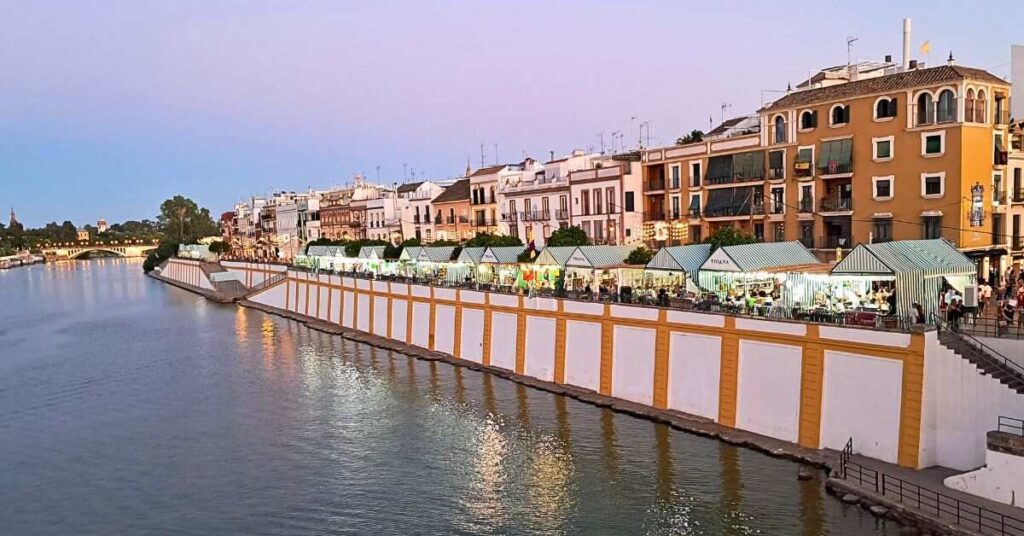
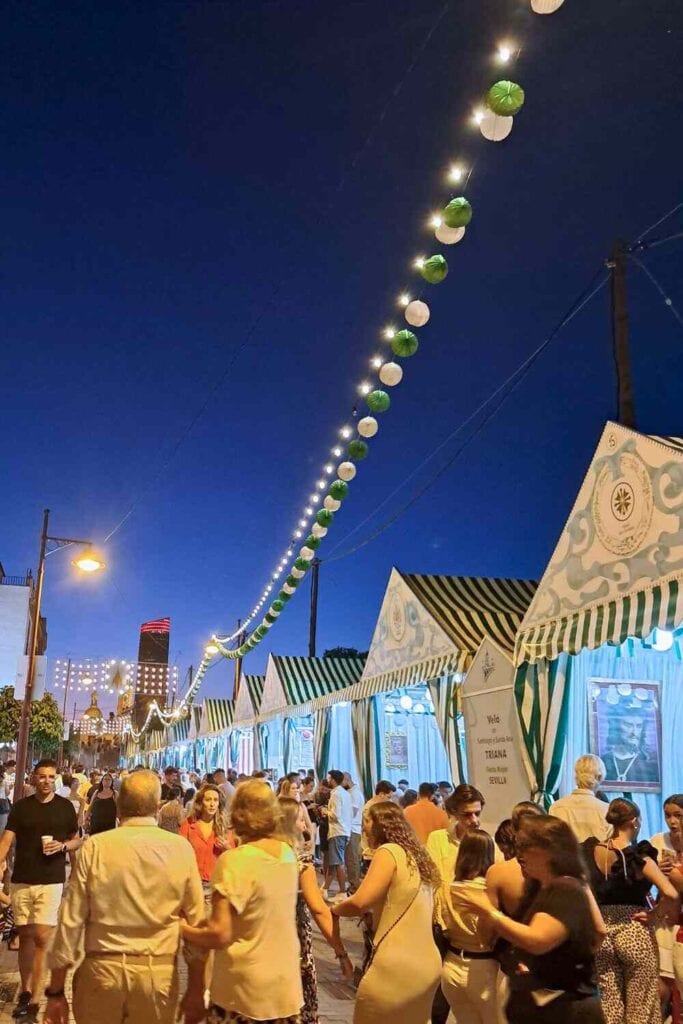
The centre of everything is Calle Betis, the riverfront street that looks across the Guadalquivir towards the Torre del Oro. During the Velá, it fills up with around 30 casetas, decorated tents and stalls selling food and drink.
By evening, it’s crowded enough that you’ll be shuffling rather than walking; by 10 pm, you’re in a proper crowd.
The food is dominated by fried fish. Pescaito frito (small whole fish, battered and fried) is the dish of the Velá, sold from most of the stalls.
You’ll also find montadito de pringá (a warm, shredded meat sandwich), grilled sardines, and green hazelnuts, which are a seasonal thing you won’t find much outside Andalusia in July.
If you’re vegetarian, vegan or coeliac, options are thin on the street stalls. The bars along Calle Betis continue operating normally throughout the week, so you’re not stuck. There are also plenty of restaurants with good veggie tapas options elsewhere.
The Concerts in Plaza del Altozano
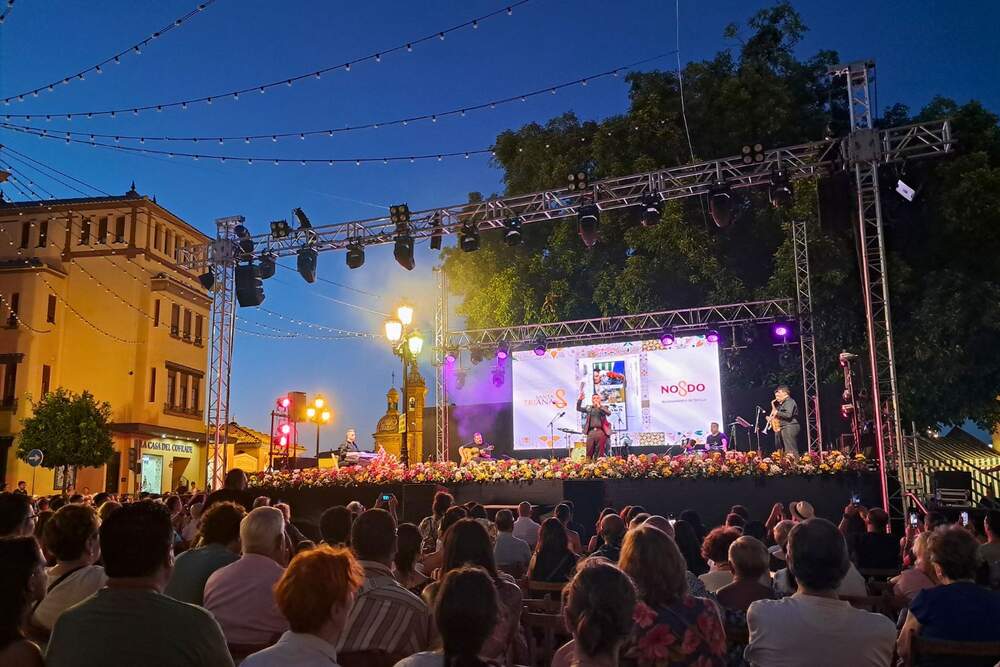
Every night from 10 pm, Plaza del Altozano, the square at the entrance to Triana just across the Triana bridge, becomes a concert venue. The programme features flamenco, sevillanas, and Andalusian pop.
The square gets packed by 10:30 pm. If you want to be anywhere near the stage, arrive before the music starts rather than once it’s already going.
The Cucaña
This is the one event that makes the Velá unlike anything else in the Seville festival calendar. Every afternoon from 6 pm, a greased pole is extended horizontally out over the Guadalquivir from the bank near Calle Betis.
Competitors take turns trying to walk along it and grab the flag at the far end, without falling into the river. Most fall into the river.
The cucaña has been part of the programme since 1910, though the idea of slippery-pole competitions has older roots in the festival’s history. The crowd along the riverbank gets very vocal when someone nearly makes it, and very loud when they fall in.
It draws spectators all along the riverbank and from the Triana bridge. Go early if you want a good spot.
The Religious Ceremonies
On 26th July, the feast day of Santa Ana, the Iglesia de Santa Ana holds a solemn high mass and a procession. The image of the Señora is carried through the streets of Triana, which fills up for the occasion.
This is the oldest part of the festival and the reason any of this started. It runs alongside the street party atmosphere rather than replacing it.
The Regata Nocturna
On the night of 22nd July, a nocturnal boat race takes place on the Guadalquivir. Crews line up along the river and set off from the Altozano area after dark. It’s less well-known than the cucaña but draws a good crowd along the riverbank and is worth watching if you’re there on the Wednesday.
The Fireworks
The Velá closes each year with fireworks over the Guadalquivir on the night of 26th July, as part of the closing ceremony. They go up after the Gala de Trianeros awards, sometime after 10 pm once the programme is underway.
The Triana Bridge fills up early. If you’d rather watch from the city side, the Arenal side of the bank (Muelle de la Sal) gives you a clear view back towards Triana with the fireworks directly ahead. Either way, get your spot before they start.

The 2026 Programme: What’s On and When
Pre-Festival: 14th to 20th July
The main festival runs 21th-26th July, but several events happen in the week before.
The one worth knowing about for visitors is the Procesión de la Virgen del Carmen on 17th July.
The image of the Virgen del Carmen is carried from the Capilla de la Estrella down to the Guadalquivir at 7 pm, where she’s transferred to a boat and processed along the river.
It’s one of the most visually striking religious events Triana puts on. If you’re already in Seville that week, go.
There’s also a photography exhibition, Triana y su gente, running 14th – 31st July at the Centro Cívico Las Columnas, and theatre performances (Corral de Comedias) at the Colegio San Jacinto on 15th and 16th July, if you want to get a feel for the neighbourhood before the main event starts.
The Concert Lineup (21st-26th July 2026)
The Altozano stage runs nightly from 10 pm.
You can see the full 2026 programme here, but these are some of the highlights for the main week:
- 21st July: Official opening with the pregón by Jesús Pozuelo
- 22nd July: Luitingo, with El Charro de Triana as guest
- 23rd July: Cantores de Híspalis, celebrating 50 years (a big deal for Seville)
- 24th July: Festival flamenco in tribute to Nano de Jerez, with Montse Cortés, La Tana and others
- 25th July: Mujeres Trianeras, with Silvia Pantoja, Rocío Díaz, La Flaka and Pilar Astola
- 26th July: Gala de Trianeros awards ceremony, then fireworks, then Los Alpresa to close
The 24th is the standout night for anyone interested in flamenco. The Cantores de Híspalis show on the 23rd will be a proper event for locals.

Why This Isn’t the Feria de Abril
People sometimes ask whether the Velá is worth going to, as though it’s a lesser version of the Feria. It isn’t a lesser version of anything. It’s a different thing entirely.
The Feria de Abril is mostly invitation-based. Most of the casetas are private; visitors watch from outside unless they’re personally invited in. The giant fairground is also a major part. It’s spectacular, but for a large part, not wholly open if you’re not linked to someone with access to a caseta.
The Velá is open. It’s free. It belongs to Triana rather than to Seville as a whole, and that neighbourhood identity is real. You can feel it in who’s there.
There’s no dress code, no hierarchy of which caseta you’re in, and no expectation beyond showing up. If you want to experience a genuine Seville neighbourhood celebration rather than observe one from a distance, this is a great festival to join in with.

What to Know Before You Go
1. The dates are always around 26th July. The festival runs 21st -26th July annually, centred on Santa Ana’s feast day. The 24th, 25th, and 26th tend to be the busiest nights.
If you only have one evening, the 24th or 25th hits the sweet spot: full atmosphere without the extreme pressure of the 26th itself. In 2026, the 24th has the flamenco tribute to Nano de Jerez and the 25th has the Mujeres Trianeras show with Silvia Pantoja.
2. Calle Betis is closed to traffic. The street is pedestrianised for the week. Public transport routes are adjusted; check Tussam’s website for updates. The simplest option is walking across the Triana bridge from the city centre, which takes around 10 minutes from the Arenal area.
3. Go early for the cucaña. It runs every afternoon from 6 pm. Be there by 5:30 if you want a decent spot on the riverbank.
4. Concerts start late. The concerts in Plaza del Altozano begin at 10 pm, which is normal for Seville but worth knowing if you’re expecting something earlier in the evening.
5. It is very hot. Loose clothes. Comfortable shoes. Water. The evenings cool to around 30-33°C (86-91.4°F), which still counts as hot.
6. The stalls stay open very late. Casetas operate until around 3 am, sometimes later. There’s no pressure to arrive early, but the streets are at their most packed between 10 pm and midnight.
7. For the religious element, go on the 26th. The procession of the Señora on Santa Ana’s feast day is the original heart of the festival. If you’re there that day, don’t skip it.
8. Budget roughly €15-20 per person for an evening. Entry is free, but a couple of drinks and something from the stalls add up. That’s a realistic figure for a few hours out. More if you’re eating a full meal, less if you’re just having a caña and a wander.
Velá de Santa Ana FAQs
Is the Velá de Santa Ana free?
Yes, completely. There’s no entry fee for any part of the festival. Food and drink from the stalls are paid for individually, at normal bar and street food prices. The nightly concerts in Plaza del Altozano are also free to attend.
What is the cucaña at the Velá de Santa Ana?
The cucaña is a horizontal greased pole extended out over the Guadalquivir River. Competitors try to walk along it to grab the flag at the far end; most end up in the water. It takes place every afternoon from 6 pm during the festival week and draws a big crowd along the riverbank and from the Triana bridge.
When is the Velá de Santa Ana 2026?
The 2026 Velá de Santa Ana runs from 21st to 26th July, as it does every year, centred on the feast day of Santa Ana on the 26th. The final days tend to be the busiest.
How do I get to the Velá de Santa Ana?
The festival is in Triana, on Calle Betis and Plaza del Altozano. The easiest approach is to walk across the Puente de Triana (also called Puente de Isabel II) from the city centre, about 10 minutes from the Arenal area. Public transport routes are adjusted during the festival week; check Tussam for current information.
Have a Question?
Ask in The Seville Guide Community!
Connect with fellow travellers and locals, share tips, and get the latest insights on what’s happening in Seville.
Keep Planning Seville in July
If you’re spending any time in Triana around the Velá, read the tapas guide: the neighbourhood has some of the best bars in Seville and most visitors miss half of them.
Our full things to do in July guide covers everything else worth doing this month.
And if the heat section above alarmed you, our article on July’s weather will give you the full picture.
Have a question? then don’t forget to join our free Facebook Group: Seville Things To Do and ask the community.
Want to discover more about Seville? then check out these other great articles to find out more.
Done-For-You Itineraries
- One Day in Seville Itinerary
- Two Days in Seville Itinerary
- Three Days in Seville Itinerary
- Five Days in Seville Itinerary
Things To See & Do In Seville
- Best Places to Watch Flamenco in Seville
- 21 Great Things to Do in Seville
- 18 Must-See Galleries and Museums in Seville
- Best Time to Visit Alcazar of Seville
- Things to Do in Seville for Free
- Best Artisan and Flea Markets in Seville
- 23 Best Day Trips From Seville
- Where’s The Nearest Beach to Seville? [Within a 2-Hour Drive]
- 34 Instagram Spots in Seville [+ Photo Location Map]
Food & Drink in Seville
- Eat Your Way Around Seville’s Top Food Markets
- Discover the Best Tapas in Triana Neighbourhood
- The Best Flamenco and Tapas Tour in Seville
- Can You Drink Tap Water in Seville?
- Where to Find the Best Breakfast in Seville
- Where to Find the Best Coffee in Seville
Seville Travel Tips
- How To Survive Seville In Summer
- Things to Do in Seville in the Rain
- What to Wear to Seville Cathedral
- What Is Seville Famous For?
- How Many Days in Seville Do You Really Need?
- How to get from Seville Airport to the City Centre
- Where to Stay in Seville, Spain: Best Neighbourhoods
- Why Visit Seville? 15 Reasons to Visit Seville