
Is Seville Safe? Safety Tips for Visitors
If you’re asking whether Seville is safe to visit, the short answer is yes. It’s one of the more relaxed cities in Spain, and most visitors have zero issues.
That said, like any city with a high volume of tourists, there are a few things worth knowing before you go.
I spent around six weeks in Seville living with a host family in Triana, which gave me a ground-level view of how the city actually works day to day.
This guide covers Seville safety from that first-hand perspective: what to watch out for, what the neighborhoods are actually like, and how to stay comfortable in the heat.

Some of the links on The Seville Guide are affiliate links. If you click through and make a purchase, we may earn a small commission. This allows us to create more helpful and honest guides that you can use for free. You can read our Disclosure Policy here. We appreciate your support, thank you.
Is Seville Safe to Visit? Quick Answer
Yes, Seville is a safe city for tourists. Violent crime is rare, and the areas where most visitors spend time are considered safe, including at night.
If it’s your first trip to the city, the main thing to be aware of is petty theft and pickpocketing in busy tourist areas. Keep your belongings secure, stay alert in crowded spots, and you’ll be fine.
One practical note before you start walking: Seville has clearly marked bike lanes on most main streets. Cyclists move fast and don’t always slow down. Stay out of those lanes, and you’ll avoid one of the most common near-misses tourists have in the city.
Have a Question?
Ask in The Seville Guide Community!
Connect with fellow travellers and locals, share tips, and get the latest insights on what’s happening in Seville.
Pickpocketing and Keeping Your Belongings Safe
If you’re using pockets or a purse to carry personal items, make sure they’re not easily accessible. Lean towards bags with a zipper or button closure. Personally, I never had any issues, but I heard enough stories during my stay to take it seriously.
Keep your passport in a safe, at wherever you’re staying.
While eating, never leave your phone or purse on the table if you step away for any reason. I’m not saying it will 100% get taken, but it is better to be alert than not.
The areas around the Cathedral, Alcázar, Plaza de España, and Las Setas are where you need to be most aware. Crowded tourist spots are where pickpockets operate, and those are the busiest in the city.
Common Scams to Watch Out For
A few scams come up regularly near Seville’s main tourist sites.
I was warned about both of these before I arrived, and they’re easy to avoid once you know what to look for.
The rosemary scam. Women near the Cathedral and Alcázar will offer you a sprig of rosemary, framed as a free gift or a blessing. Once you take it, they demand payment. Don’t take the rosemary, even if it’s pushed toward you.
The clipboard scam. Someone approaches you with a clipboard, asking you to sign a petition. While you’re focused on that, an accomplice goes through your bag or pockets. If someone approaches you out of nowhere with a clipboard, keep walking.
Overpriced menus near major sights. Not a scam exactly, but restaurants immediately outside the Cathedral and Alcázar charge significantly more than everywhere else. Walk two or three streets away, and the prices drop noticeably.
What to Do if You Get Robbed in Seville
The first thing: don’t chase the person. It’s not worth it.
Seville has a dedicated tourist assistance office called SATE (Servicio de Atención al Turista Extranjero), run by the national police specifically to help visitors.
Staff speak English and can take your report and guide you through the process.
To find the Seville office location, call 091 or check www.policia.es.
Here’s what to do, step by step:
- Call 112 if you need immediate help. This is Spain’s emergency number for police, ambulance, and fire. Use it if you’ve been threatened or need urgent assistance.
- Call 091 to contact the national police, report a crime, or get information on where to go.
- File a denuncia. This is the official police report required for any insurance claim. You can do this at the nearest Policía Nacional station, through SATE, online, or by calling the tourist reporting line on 902 102 112 (English and French: 9 am to 9 pm; Italian and German: 9 am to 3 pm).
- Use the AlertCops app if you prefer. It’s a free official Spanish police app that lets you report crimes or risky situations directly to the police.
- Cancel your cards immediately. Contact your bank as soon as you can.
- Contact your embassy or consulate if your passport was taken. Most have emergency contact lines.
Keep a copy of the denuncia. Your insurer will ask for it.
SEVILLE ITINERARY REVIEW
Not sure if your Seville itinerary actually works?
Send us your rough plan, and we’ll check it from a local point of view.
We’ll look at timings, ticket slots, walking distances, neighbourhood order, and anything that might make your trip feel rushed or harder than it needs to be.
- Find out what to keep
- See what to swap or skip
- Fix awkward timings before you book
- Get honest local feedback by email
Is Seville Safe at Night?
Yes. Seville comes alive at night, and locals are out late as a matter of routine.
Families eat dinner at 9 or 10 pm, kids included. You will see people of all ages out at midnight on a weekday. That’s just how the city works.
The main tourist neighborhoods are all fine to walk at night.
I walked back from Triana to the center at midnight and felt completely fine. The city center stays busy well into the early hours, which makes it feel safer than quieter cities at night.
Where to Stay in Seville for Safety
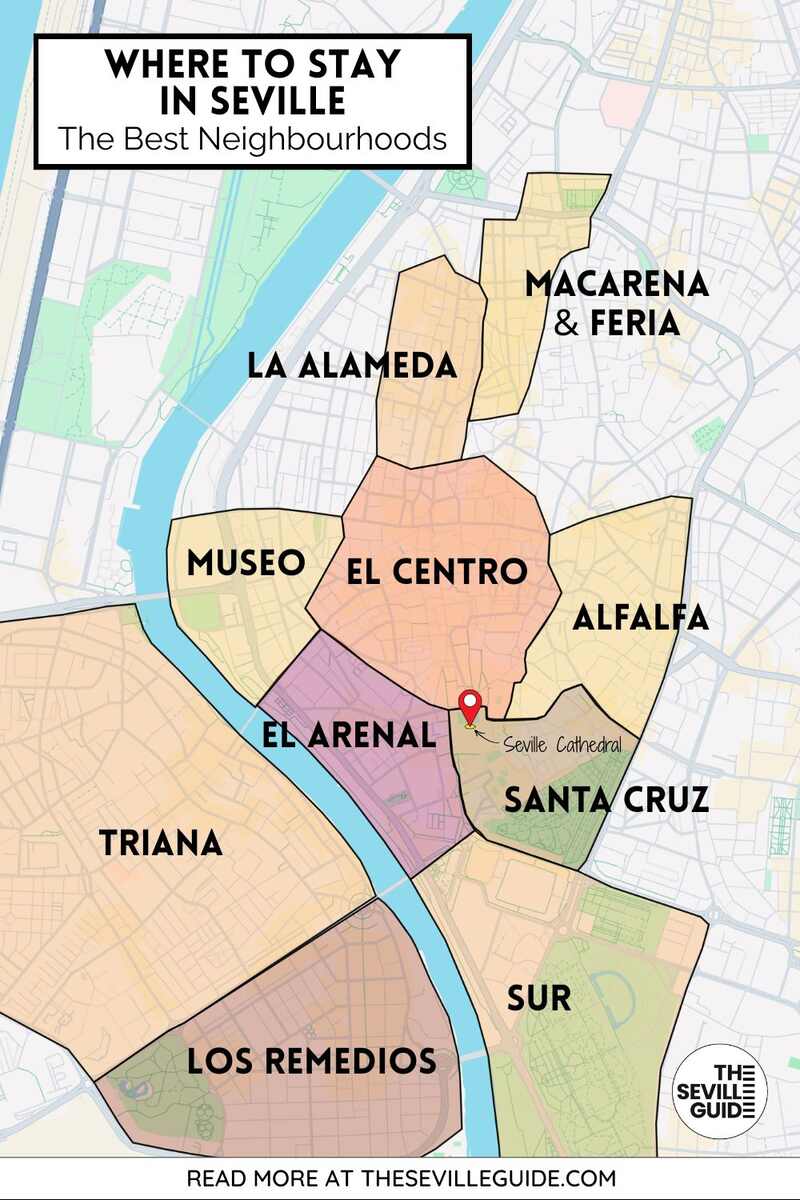
All the main tourist neighborhoods are safe. Here’s a quick breakdown:
- Santa Cruz and the Historic Center. The most central option, well-lit and busy at all hours. The most popular choice for first-time visitors.
- Triana. Residential and local. I lived here for six weeks and felt completely safe throughout. Great if you want a quieter, more authentic experience just across the river.
- El Arenal. Close to the river and well-connected. Safe and convenient.
- Alameda de Hércules. A more bohemian area, popular with locals. Safe during the day and evening.

Good To Know
For a full breakdown of each neighborhood with accommodation options, our in-depth article about where to stay in Seville covers everything.
Is Triana Safe?
Yes, Triana is safe. I lived there for six weeks with a host family, and it’s one of the most authentically residential neighborhoods in the city. There’s nothing to worry about as a tourist staying or spending time in Triana.
Areas to Avoid in Seville
The areas to be aware of are Polígono Sur, which includes the Las 3.000 Viviendas neighborhood to the south, Los Pajaritos to the east, and parts of Polígono Norte.
All three have higher crime rates and get flagged in safety guides.
None of them are anywhere near a tourist attraction, and most visitors never have a reason to set foot in any of them.
If you’re staying in or around the historic center, Triana, or any of the main tourist neighborhoods, you’re in safe areas.
Is Seville Safe for Solo Female Travelers?
Yes. I stayed in Seville for six weeks. As a young woman living in a residential neighborhood, I didn’t have any problems.
Seville is one of the easier cities in Spain for solo female travelers.
Street harassment exists in Spain the same as anywhere in Southern Europe, but from my experience, Seville was relatively mild compared to what I’d been told to expect.
Walking alone in Triana and the historic center during the day felt completely normal.
At night, the same sensible rules apply that you’d follow anywhere.
Stay on lit, populated streets. If you’re at a bar or nightlife venue, keep an eye on your drink. Trust your instincts if something feels off. That applies everywhere, not just Seville.
The fact that locals are out so late actually works in your favor. You’re rarely the only person on the street, even at midnight.

Staying Safe in Seville’s Heat
Seville in summer is very hot.
Temperatures can hit 40°C (104°F) in July and August, and heatstroke is a genuine risk for visitors who aren’t used to it. This is less about sightseeing comfort and more about staying safe.
The most important thing: avoid being outside during peak heat hours, which run roughly from noon to 8 pm in summer.
There’s a reason locals take a siesta. Use that time to eat, rest indoors, or visit air-conditioned museums.
A few things that help for the rest of the day:
Clothing. Lightweight, breathable fabrics like linen or modal make a real difference. More airflow, less heat building up against your skin.
Hair. If you have longer hair, carry a hair clip. I use one if I start heating up because it won’t ruin my style when I take it back down.
Water and sunscreen. Carry water and drink it constantly, not just when you feel thirsty. Reapply sunscreen. The heat is dry, which means you won’t always feel how much sun you’re getting until it’s already too late.
Fans. There’s a Spanish chain called Ale-Hop with several locations across the city. You’ll probably walk past one during your stay; they have their signature spotted cow standing outside every store. They sell hand fans, both automatic and manual, and having one makes a noticeable difference while you’re walking around, plus it makes a great souvenir to take home.

Safety in Seville FAQs
Is Seville safe?
Yes. Violent crime in Seville is rare, and the overall crime rate is low by European standards. The main risk for tourists is petty theft and pickpocketing in busy areas, not anything more serious. Locals are friendly, the city is well-lit at night, and you’re unlikely to feel unsafe anywhere in the main tourist areas.
How do I keep my bag safe in Seville?
If I have a purse, I keep it closer to my armpit with a short strap so I always know where it is. Avoid bags that hang loosely or open at the top. In busy spots around the Cathedral and Alcázar, wear it in front of you rather than on your back.
Are there specific scams targeting tourists in Seville?
Yes, two come up regularly near the main sights. The rosemary scam: women offer a free sprig near the Cathedral, then demand payment. The clipboard scam: someone distracts you with a petition while an accomplice goes through your bag. Both are covered in detail above.
Ready to Start Planning Your Seville Trip?
Seville is safe. Stop worrying about it and focus on the city itself.
Personally, knowing I was staying in a residential neighborhood with a host family made the whole trip feel a lot more grounded from day one.
If you’re still figuring out where to base yourself, our guide on where to stay in Seville breaks down every neighborhood so you can pick the right area.
And if you want help putting the whole trip together, the Seville trip planning service pairs you with someone who actually lives here.
SEVILLE ITINERARY REVIEW
Not sure if your Seville itinerary actually works?
Send us your rough plan, and we’ll check it from a local point of view.
We’ll look at timings, ticket slots, walking distances, neighbourhood order, and anything that might make your trip feel rushed or harder than it needs to be.
- Find out what to keep
- See what to swap or skip
- Fix awkward timings before you book
- Get honest local feedback by email
Have a question? then don’t forget to join our free Facebook Group: Seville Things To Do and ask the community.
Want to discover more about Seville? then check out these other great articles to find out more.
Done-For-You Itineraries
- One Day in Seville Itinerary
- Two Days in Seville Itinerary
- Three Days in Seville Itinerary
- Five Days in Seville Itinerary
Things To See & Do In Seville
- Best Places to Watch Flamenco in Seville
- 21 Great Things to Do in Seville
- 18 Must-See Galleries and Museums in Seville
- Best Time to Visit Alcazar of Seville
- Things to Do in Seville for Free
- Best Artisan and Flea Markets in Seville
- 23 Best Day Trips From Seville
- Where’s The Nearest Beach to Seville? [Within a 2-Hour Drive]
- 34 Instagram Spots in Seville [+ Photo Location Map]
Food & Drink in Seville
- Eat Your Way Around Seville’s Top Food Markets
- Discover the Best Tapas in Triana Neighbourhood
- The Best Flamenco and Tapas Tour in Seville
- Can You Drink Tap Water in Seville?
- Where to Find the Best Breakfast in Seville
- Where to Find the Best Coffee in Seville
Seville Travel Tips
- How To Survive Seville In Summer
- Things to Do in Seville in the Rain
- What to Wear to Seville Cathedral
- What Is Seville Famous For?
- How Many Days in Seville Do You Really Need?
- How to get from Seville Airport to the City Centre
- Where to Stay in Seville, Spain: Best Neighbourhoods
- Why Visit Seville? 15 Reasons to Visit Seville


